Que cherchez-vous?

When you buy nurse uniforms, have you ever noticed this—two uniforms that look the same, but one feels crisp and structured, making the wearer look sharp whether standing or sitting, while the other feels limp and wrinkled the moment it's put on, almost like sleepwear.
Both are called "nurse uniforms," both are labelled "65/35 poly-cotton"—so why is the hand-feel so different? The problem isn't the words "poly-cotton." There are three more specific indicators: fabric weight, yarn count, and finishing process.
Today, we're going to break these three down—what they are, how they affect hand-feel and wearability, what to ask during procurement, and how to judge quality.
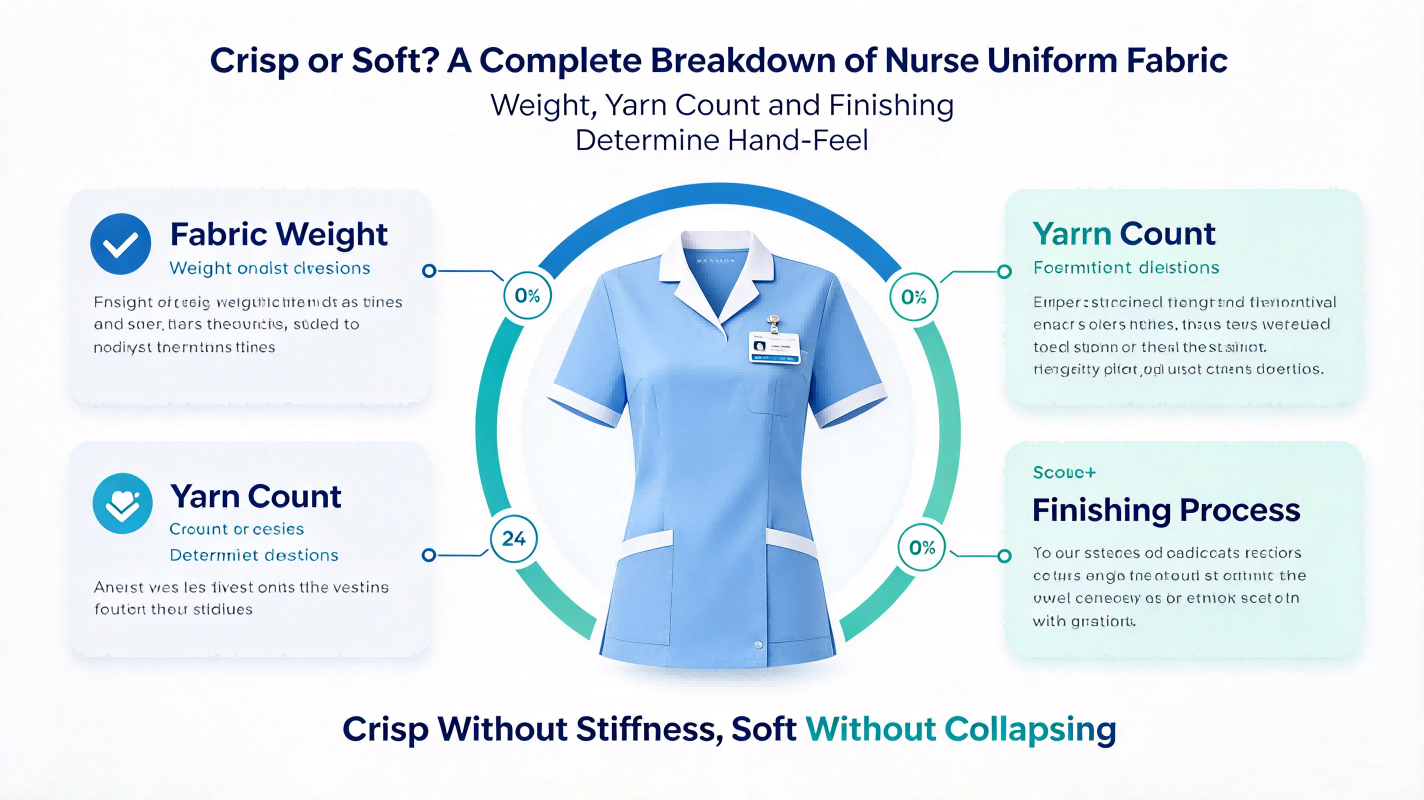
1. First, let's get clear: crisp or soft—which is better?
Don't pick a side too quickly. For nurse uniforms, crisp and soft aren't about "which is better" – they're about different scenarios needing different hand-feels.
Crisp nurse uniforms – structured, wrinkle-resistant, professional-looking. Suitable for outpatient clinics, health check centres, and administrative roles. But too crisp and they feel stiff, restrict movement, and feel "boardy" against the body.
Soft nurse uniforms – skin-friendly, easy to move in, comfortable. Suitable for wards, paediatrics, ICU, and other departments that require long periods of movement and bending. But too soft and they wrinkle easily, lose their shape, and look less sharp.
The ideal state is "crisp without being stiff, soft without collapsing"—the fabric has structure without being rigid; the hand-feel is soft but with support. This balance is achieved by adjusting three indicators: weight, yarn count, and finishing.
What is fabric weight?
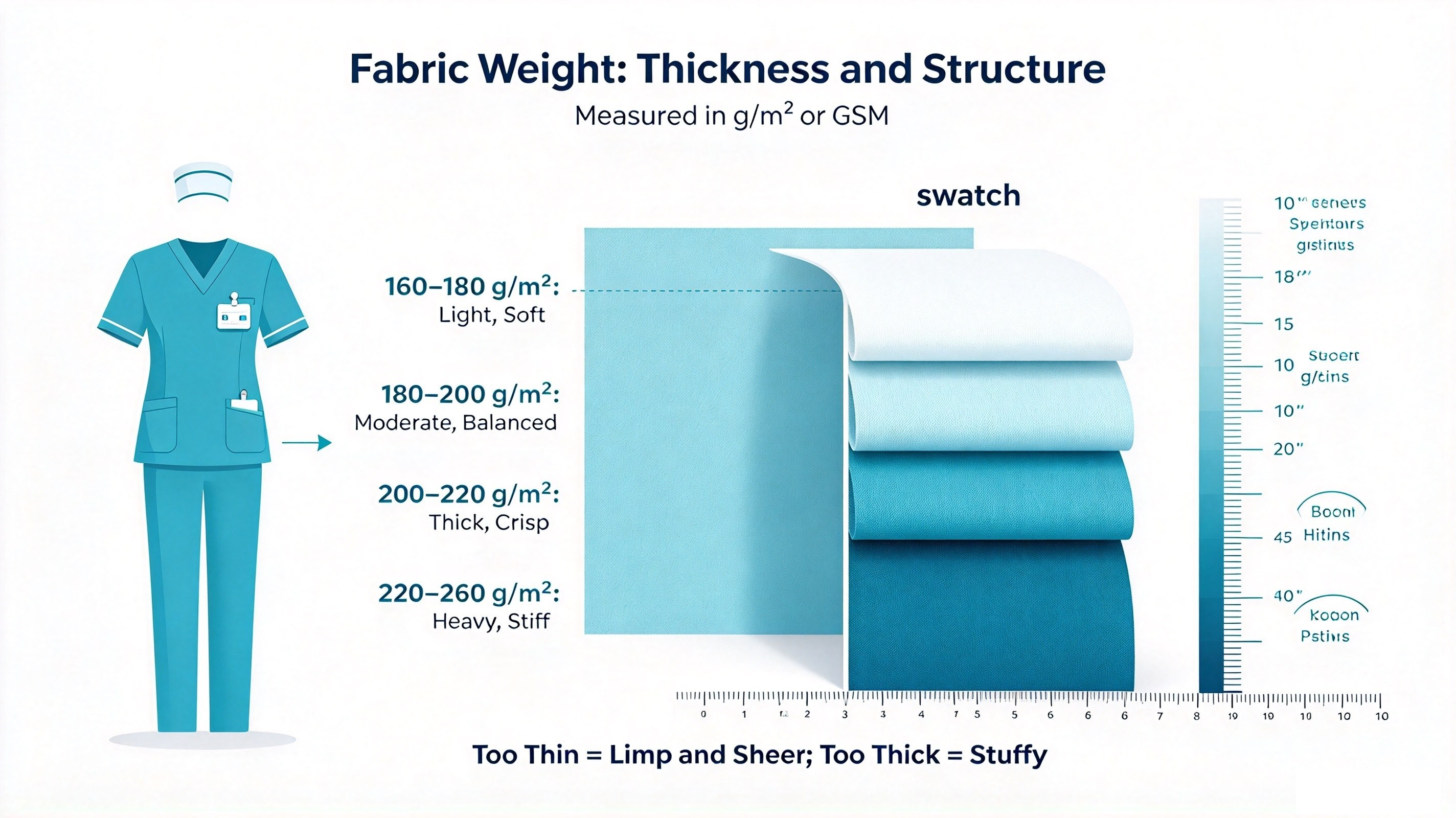
Fabric weight is the weight per square metre of fabric, measured in grams per square metre (g/m² or GSM) . It's the most direct indicator of fabric thickness.
How does weight affect nurse uniforms?
Higher weight means thicker fabric, better crispness, and stronger abrasion resistance. Lower weight means lighter, more breathable fabric, but less crispness.
Common weight ranges for nurse uniforms:
| Weight range | Hand-feel characteristics | Suitable scenarios |
|
160–180 g/m² |
Light, soft, breathable | Summer short-sleeve nurse uniforms, high-temperature departments |
| 180–200 g/m² | Moderate, balanced | Regular nurse uniforms, all-season |
| 200–220 g/m² | Thick, crisp | Spring/autumn nurse uniforms, outerwear |
| 220–260 g/m² | Heavy, stiff | Winter nurse uniforms, scrub suits, isolation gowns |
What happens if you choose the wrong weight?
Too thin (below 160 g/m²) – the uniform feels limp, loses its shape, and becomes see-through. If a white nurse uniform isn't heavy enough, the outline of undergarments can show through—very awkward.
Too thick (above 220 g/m²) – stuffy in summer, uncomfortable after a full shift. Movement is also restricted – bending and raising arms become difficult.
What to ask during procurement?
Don't just ask "Is it thick?" Ask directly: "What's the fabric weight in grams per square metre?" A legitimate supplier can answer immediately. If they can't, they probably can't explain what fabric they're using.
A quick tip: Weigh it in your hand. For the same size uniform, higher weight feels noticeably heavier. You can also hold it up to the light – too-thin fabric is obviously translucent, while sufficient weight blocks more light.
3. Yarn count: determines "how fine" and "how soft"
What is yarn count?
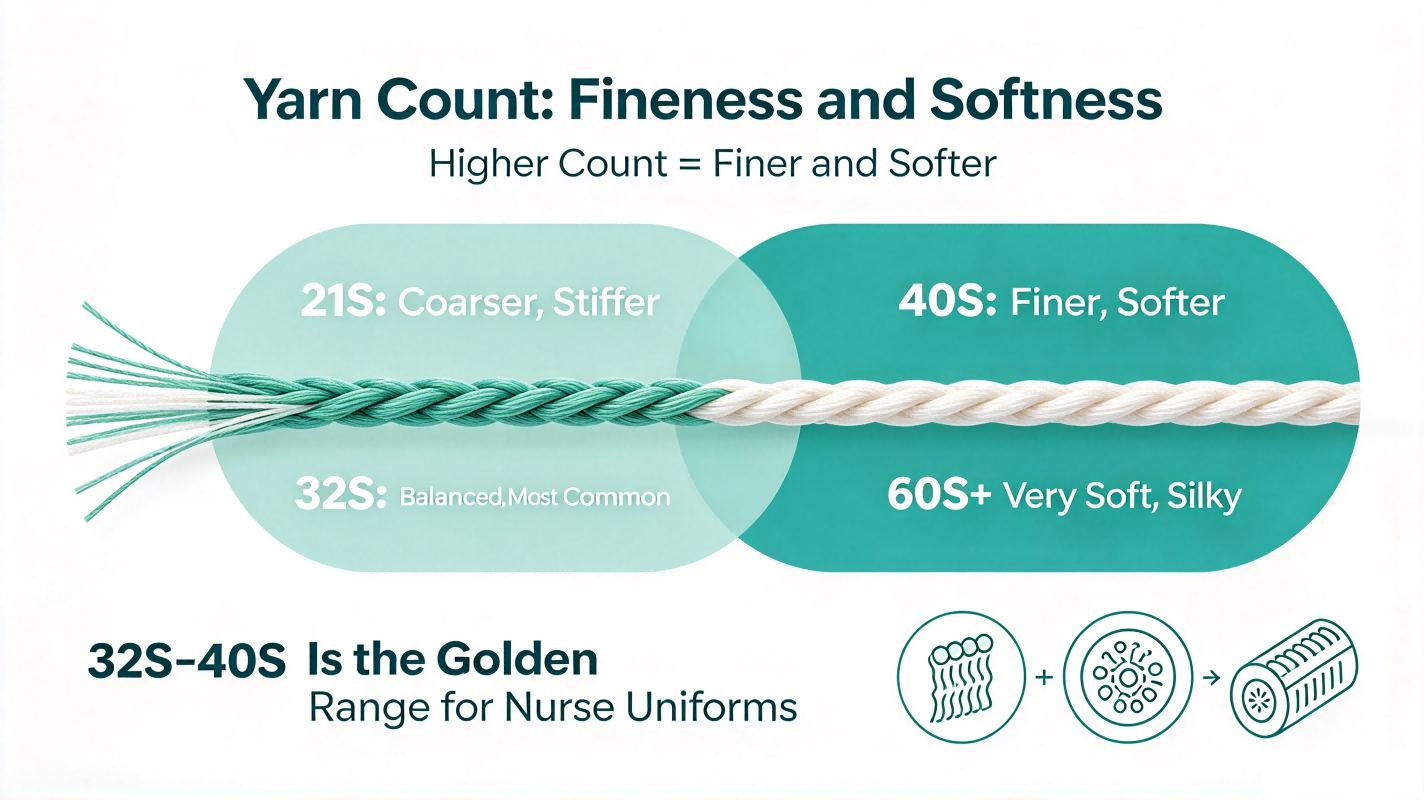
Yarn count is an indicator of yarn thickness. The higher the count, the finer the yarn; the lower the count, the coarser the yarn.
There are two common ways to express it:
- English count (S): Under standard moisture regain, the number of 840-yard lengths in one pound of yarn. 32S means 32 of those 840-yard lengths.
- Metric count (Nm): The number of metres in one gram of yarn.
Common yarn count ranges for nurse uniform fabric:
| Yarn count | Yarn thickness | Hand-feel characteristics | Suitable scenarios |
| 21S | Coarser | Thick, stiff, abrasion-resistant | Low-end workwear, thick outerwear |
| 32S | Medium | Balanced, versatile | Regular nurse uniforms, most common |
| 40S | Finer | Delicate, soft, smooth | Mid-to-high-end nurse uniforms |
| 60S and above | Very fine | Very soft, silky | High-end nurse uniforms, next-to-skin garments |
How does yarn count affect nurse uniforms?
The higher the yarn count, the finer, softer, and smoother the fabric. 40S fabric feels noticeably more comfortable than 21S, and doesn't irritate the skin when worn next to the body. But a higher count means relatively lower fabric strength and reduced abrasion resistance – 60S is soft, but not durable.
The lower the yarn count, the coarser, stiffer, and more abrasion-resistant the fabric. 21S feels stiff and uncomfortable, but is extremely strong. Suitable for high-strength scenarios, such as psychiatry.
The golden balance for nurse uniforms: 32S to 40S.
32S is currently the most commonly used yarn count for nurse uniforms—the best balance between fineness and durability, at a moderate price. 40S is softer and more skin-friendly, suitable for departments with high comfort requirements (such as paediatrics and wards), but costs more.
What to ask during procurement?
Ask: "What's the yarn count? Is it 32S or 40S?" If the supplier says "our fabric is very fine" but can't specify the count, that's a red flag.
Note: Yarn count must be considered together with weight. The same 32S yarn in 180 gsm and 220 gsm fabric feels completely different in hand and crispness. Asking only about yarn count without weight is only getting half the picture.
5. How to combine the three indicators? A quick table
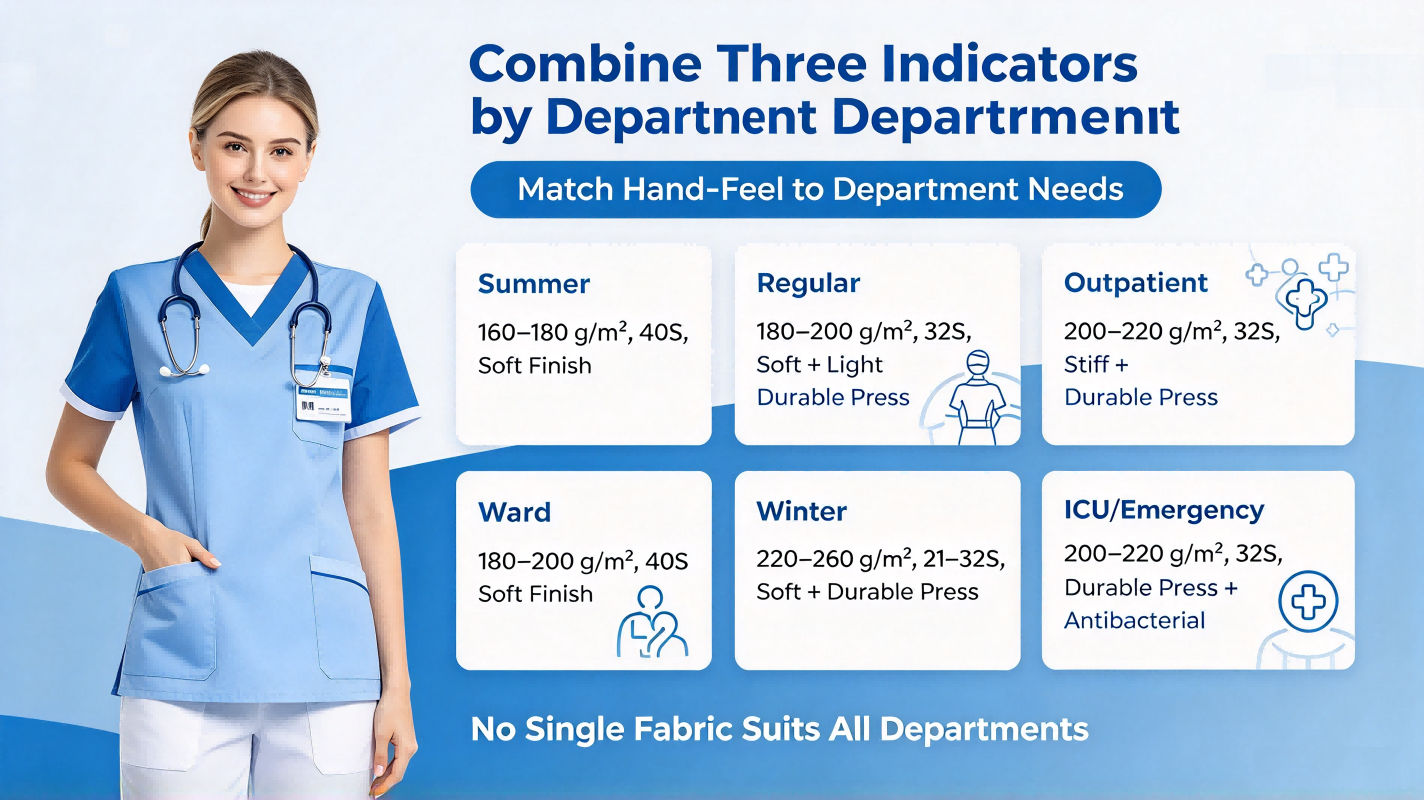
| Requirement scenario | Weight | Yarn count | Finishing | Effect |
| Summer lightweight breathable | 160–180 | 40S | Soft finish | Light, soft, breathable |
| Regular all-season | 180–200 | 32S | Soft + light durable press | Balanced, crisp without stiffness |
| Outpatient crisp and structured | 200–220 | 32S | Stiff + durable press | Crisp, smooth, professional |
| Ward comfortable skin-friendly | 180–200 | 40S | Soft finish | Soft, skin-friendly, easy to move |
| Winter thick and warm | 220–260 | 21–32S | Soft + durable press | Thick, crisp, warm |
| ICU/Emergency durable | 200–220 | 32S | Durable press + antibacterial | Durable, wash-resistant, functional |
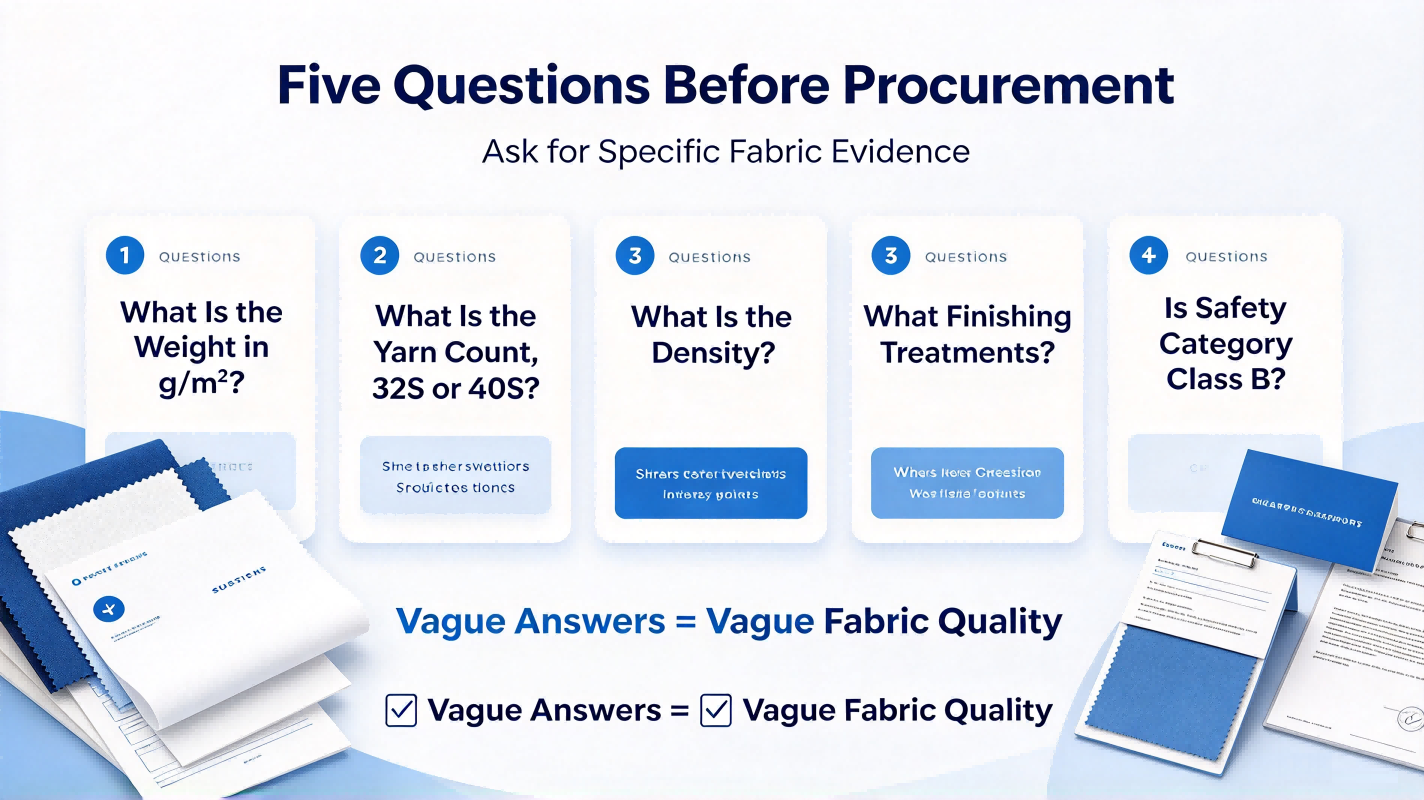
6. Five questions you must ask during procurement
First, what's the weight? Ask the supplier to state the weight in g/m². Don't accept vague answers like "medium thickness" or "on the thicker side."
Second, what's the yarn count? 32S or 40S? Combed or carded? Combed yarn is finer and more wash-resistant than carded yarn, and costs more.
Third, what's the density? Density is the number of warp and weft threads per square inch, usually written as "warp × weft," e.g. 110×70. Density must be considered together with weight and yarn count to judge the fabric's true quality.
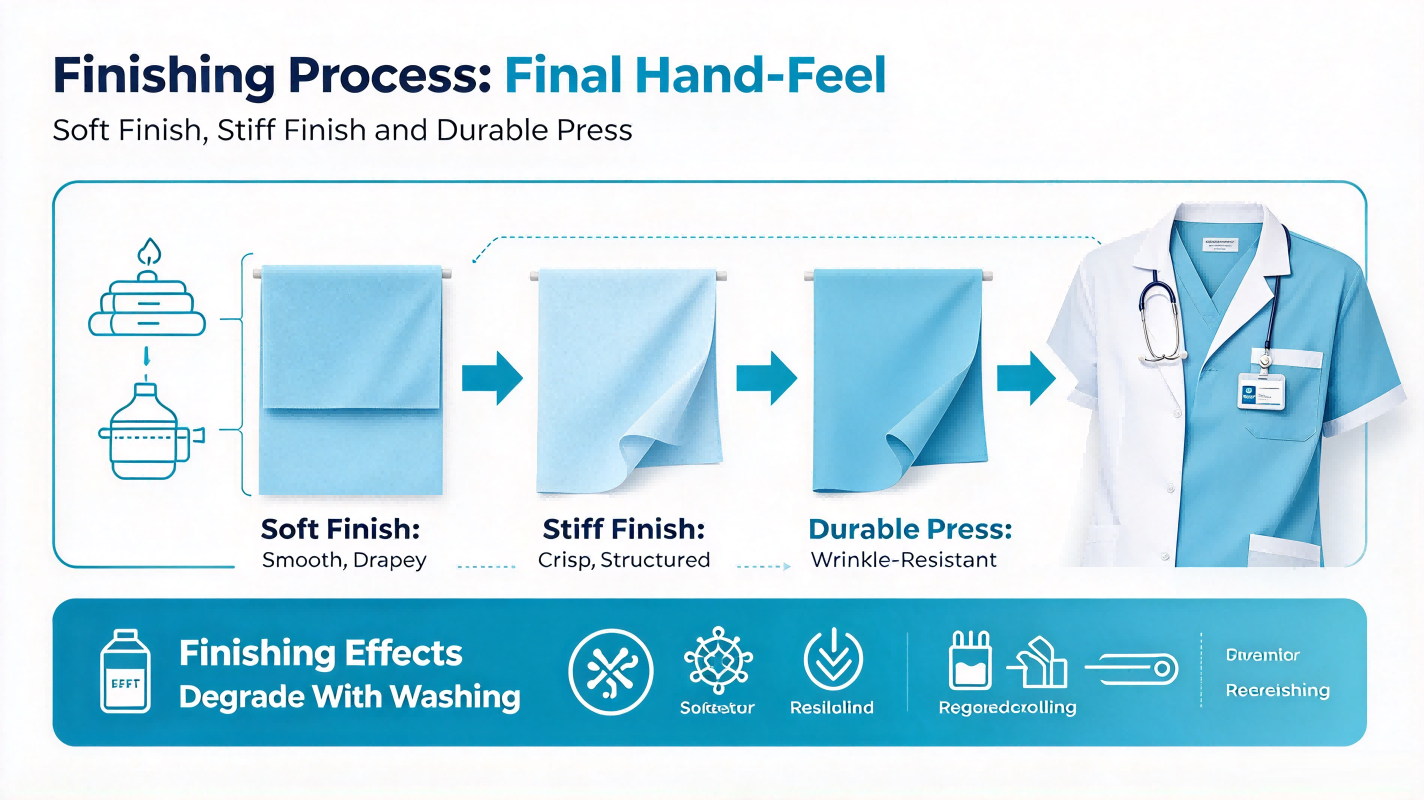
Fourth, what finishing treatments were done? Soft finish, stiff finish, durable press—which ones? How many washes will the hand-feel last?
Fifth, is the safety category Class B or Class C? Nurse uniforms come into direct contact with skin, so they must meet GB 18401-2010 Class B requirements. Durable press may involve formaldehyde, so check the test report.
7. A common misconception
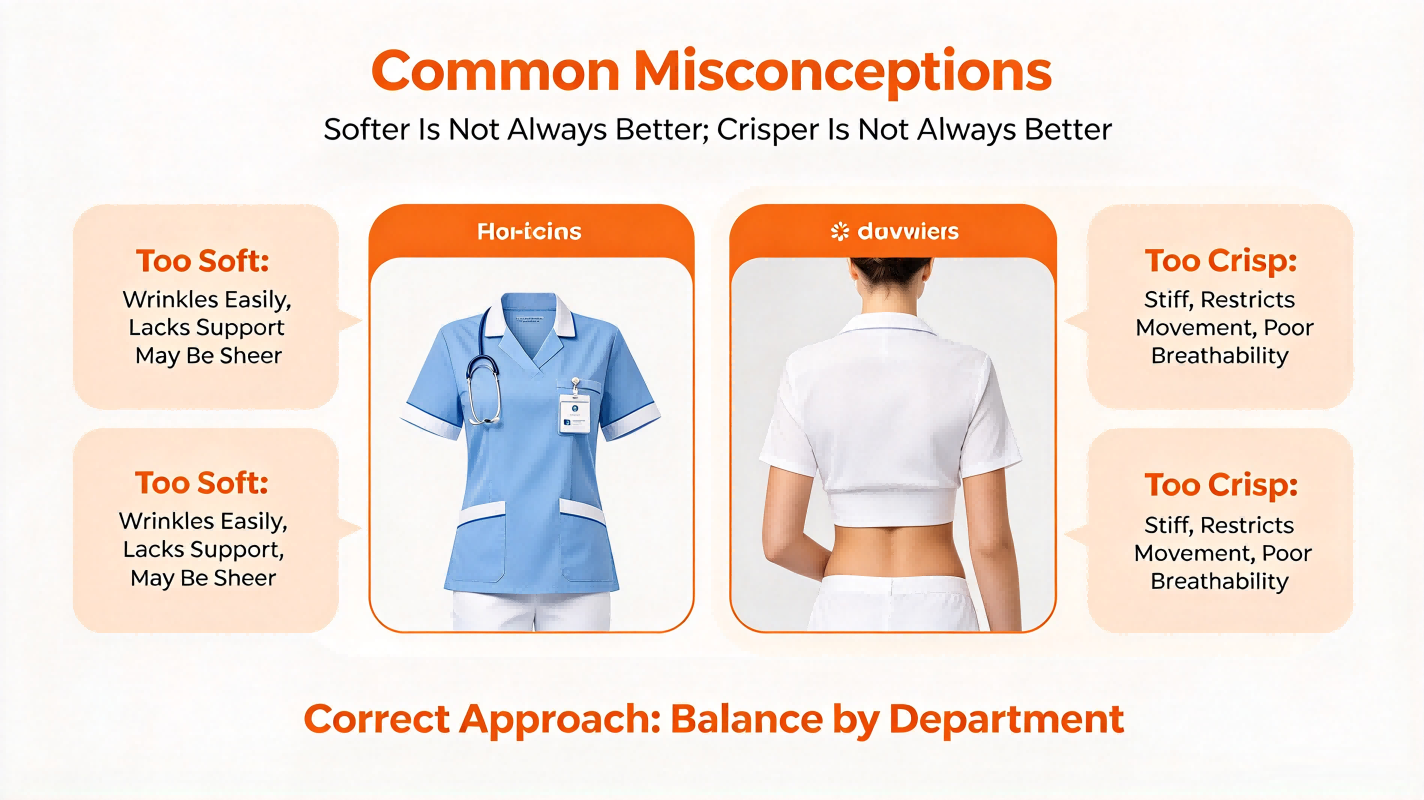
"The softer, the better" – not necessarily.
Many buyers think nurse uniforms should be as soft as possible, but that's not true. Too-soft nurse uniforms:
- Wrinkle easily and collapse after a short wear;
- Lack support, so the fabric pulls and deforms when bending or raising arms;
- Cling to the body, restricting movement;
- White nurse uniforms that are too soft become see-through.
"The crisper, the better" – also not right.
Too-crisp nurse uniforms:
- Feel stiff and uncomfortable;
- Restrict movement – bending and raising arms are less flexible;
- Poor breathability, stuffy in summer;
- After a few washes, the stiff finish washes out and the hand-feel suddenly deteriorates.
The correct approach is to find the balance point according to department needs. Outpatient clinics need crisp; wards need soft; ICU needs durable; paediatrics needs skin-friendly. No single fabric suits all departments.
A final honest word
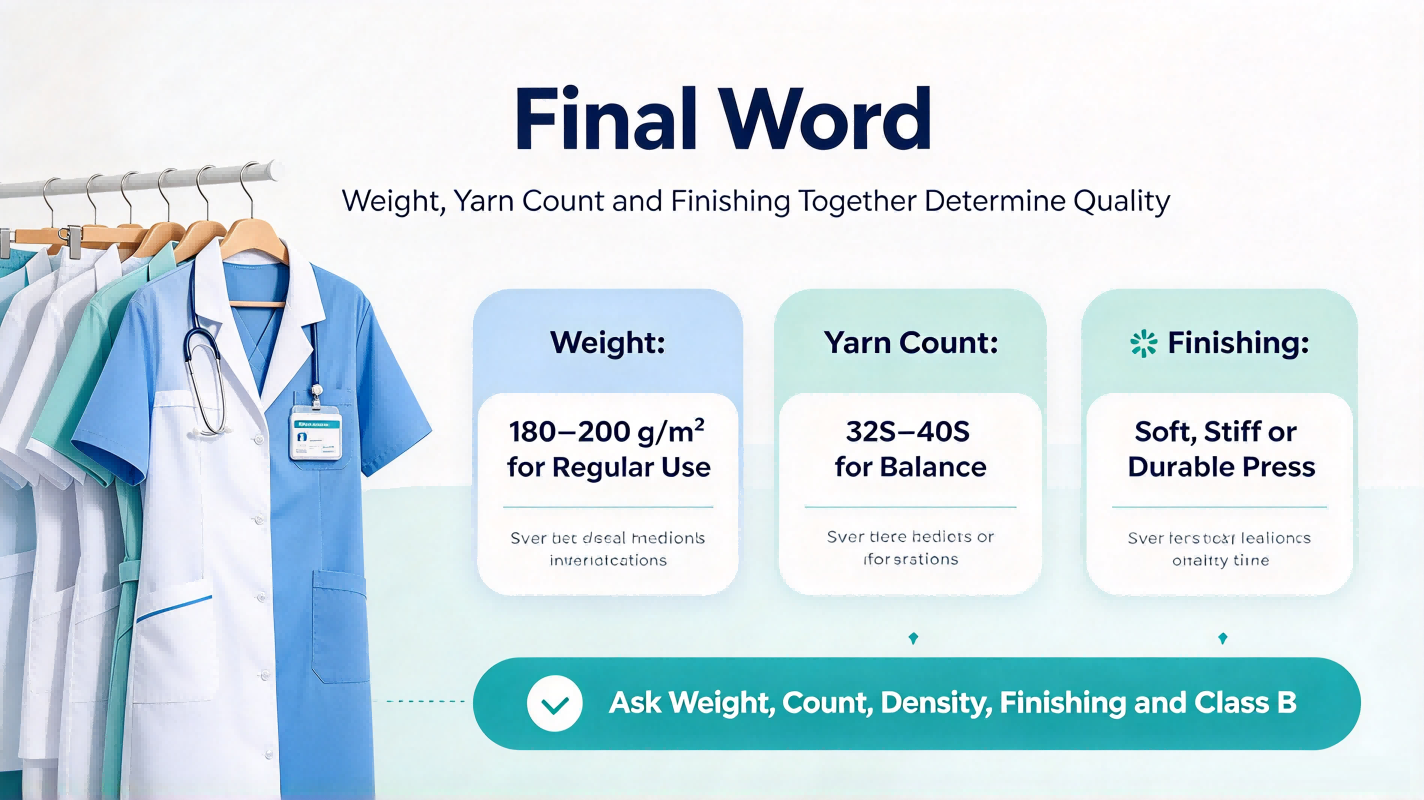
Whether a nurse uniform is crisp or soft isn't mysterious – it's the combined result of weight, yarn count, and finishing.
Weight determines thickness and structure – too thin has no shape, too thick is stuffy. 180–200 g/m² is the golden range for regular nurse uniforms.
Yarn count determines fineness and softness – 32S is the balance point, 40S is more comfortable but more expensive, 21S is too coarse for nurse uniforms.
Finishing determines the final hand-feel – soft finish makes fabric soft, stiff finish makes fabric crisp, durable press keeps it wrinkle-free.
When buying, don't just ask "How much per metre?" Ask directly: "What's the weight? What's the yarn count? What's the density? What finishing was done? Is the safety category Class B?" – A supplier who can answer these five questions clearly is a supplier who truly understands fabric.
Nurse uniforms are worn 8 to 12 hours a day. The right hand-feel directly affects comfort, ease of movement, and professional appearance. Choose the right fabric, and nurses suffer less while hospitals spend less.