Que cherchez-vous?


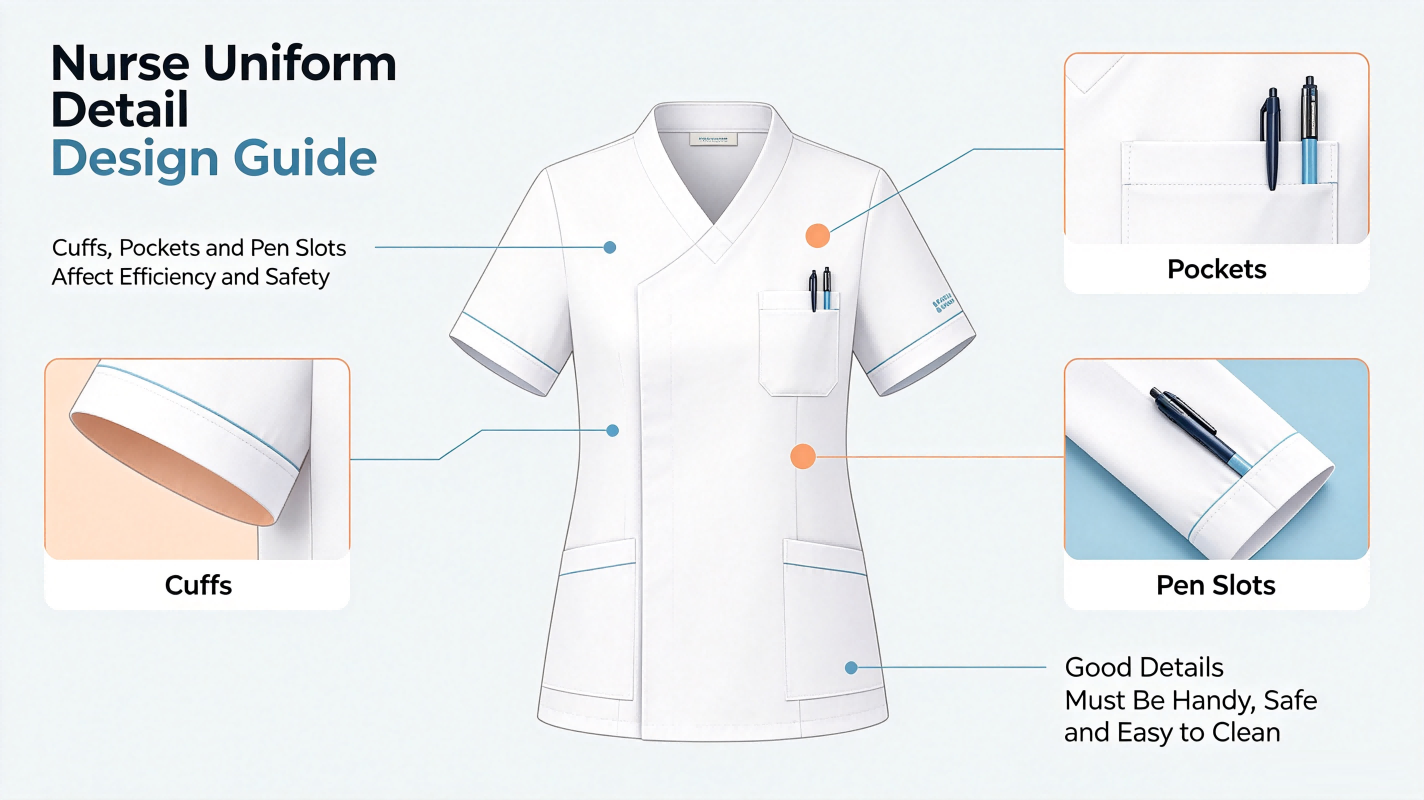
When buying nurse uniforms, most people look first at fabric, colour, and size. Few take the time to seriously examine the "small details" like cuffs, pockets, and pen slots. But nurses wear these uniforms 8 to 12 hours a day, and it's often these very details that truly affect work efficiency and wearing comfort.
Cuffs too tight make putting on gloves a struggle; cuffs too loose catch on bed rails when bending; pockets too shallow mean phones and pens fall out the moment you lean over; pockets too deep mean fumbling around to retrieve items; pen slots in the wrong position lead to ink leaks staining the uniform, or the pen tip poking into your chest when bending; pockets without compartments mean tape, cotton swabs, pens, and keys all jumbled together, forcing you to search by touch.
The detailed design of nurse uniforms isn't about "looking good or not"—it directly relates to operational efficiency, occupational safety, infection control, and wearing comfort. Today, we're going to break down the three most commonly used details—cuffs, pockets, and pen slots—covering common designs, their pros and cons, how to choose for different departments, and how to inspect them during procurement.
1. Cuffs: the detail that most affects operation and infection control
Cuffs are the part of the nurse's uniform closest to the hands, and the first to be affected during hand hygiene, glove donning, procedures, and cleaning/disinfection.
Why can't cuff design be arbitrary?
First, it affects hand hygiene and glove use. Nurses perform hand hygiene countless times a day, and donning/doffing gloves is routine. If cuffs are too tight, they get stuck at the wrist when putting on gloves, the glove edge can't cover the cuff properly, and it tends to roll up. If cuffs are too loose, they slide down and cover the glove edge, interfering with procedures and increasing contamination risk.
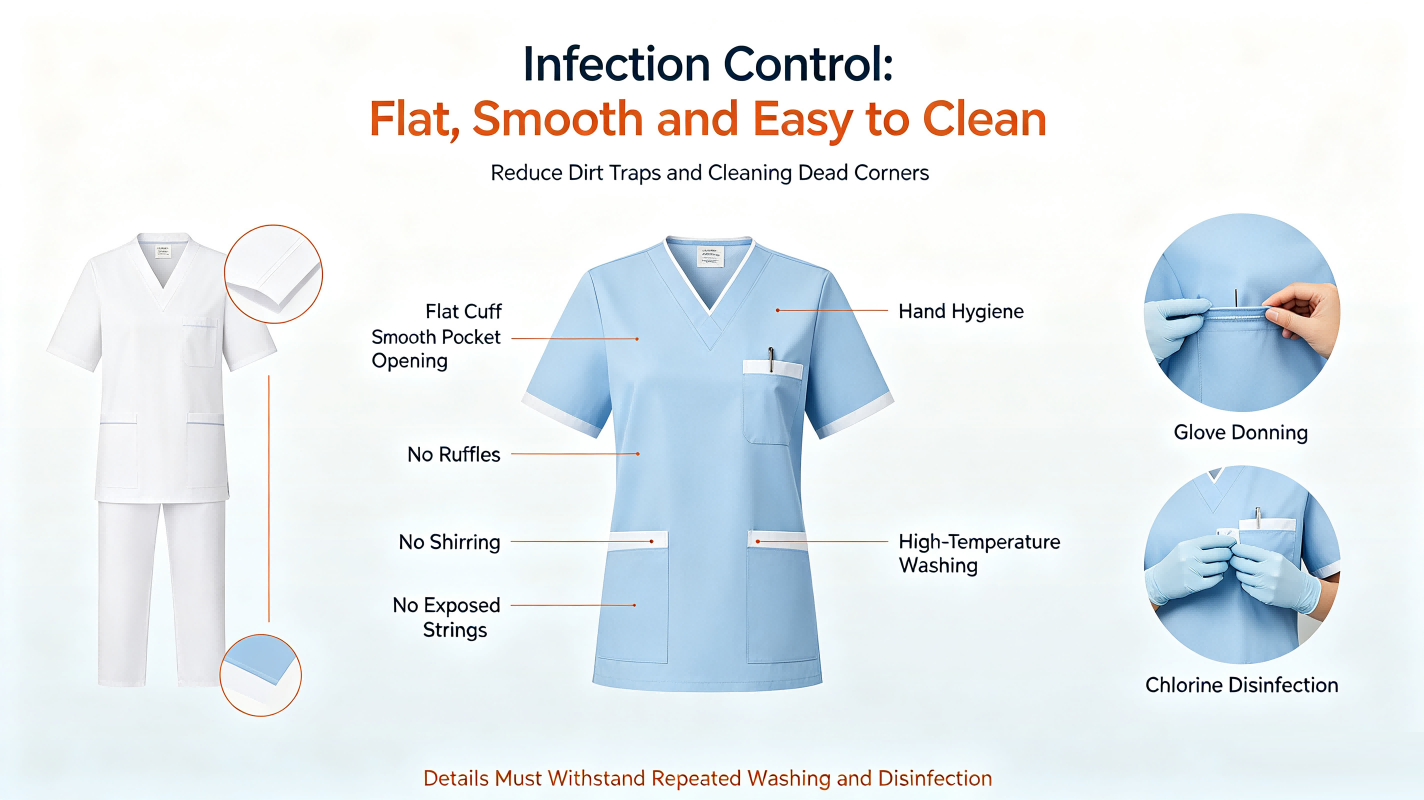
Second, it affects contamination control. Cuffs are the part most likely to contact patients' body fluids, secretions, and contaminated surfaces. If cuffs are designed with turn-ups, ruffles, or elastic shirring, they easily trap dirt, creating dead corners during cleaning and disinfection. Following the principles of medical textile washing and disinfection, nurse uniform details should be flat, with minimal wrinkles and dead corners, easy to clean, and able to withstand high temperatures and chlorine disinfection.
Third, it affects safety. If cuffs have exposed drawstrings, overly long sleeve tabs, or loose elastic, they can catch on bed rails, carts, or equipment when moving patients or operating devices, causing pulling or even falls. As workwear, nurse uniforms should minimise strings and free ends; necessary adjustments should be fixed.
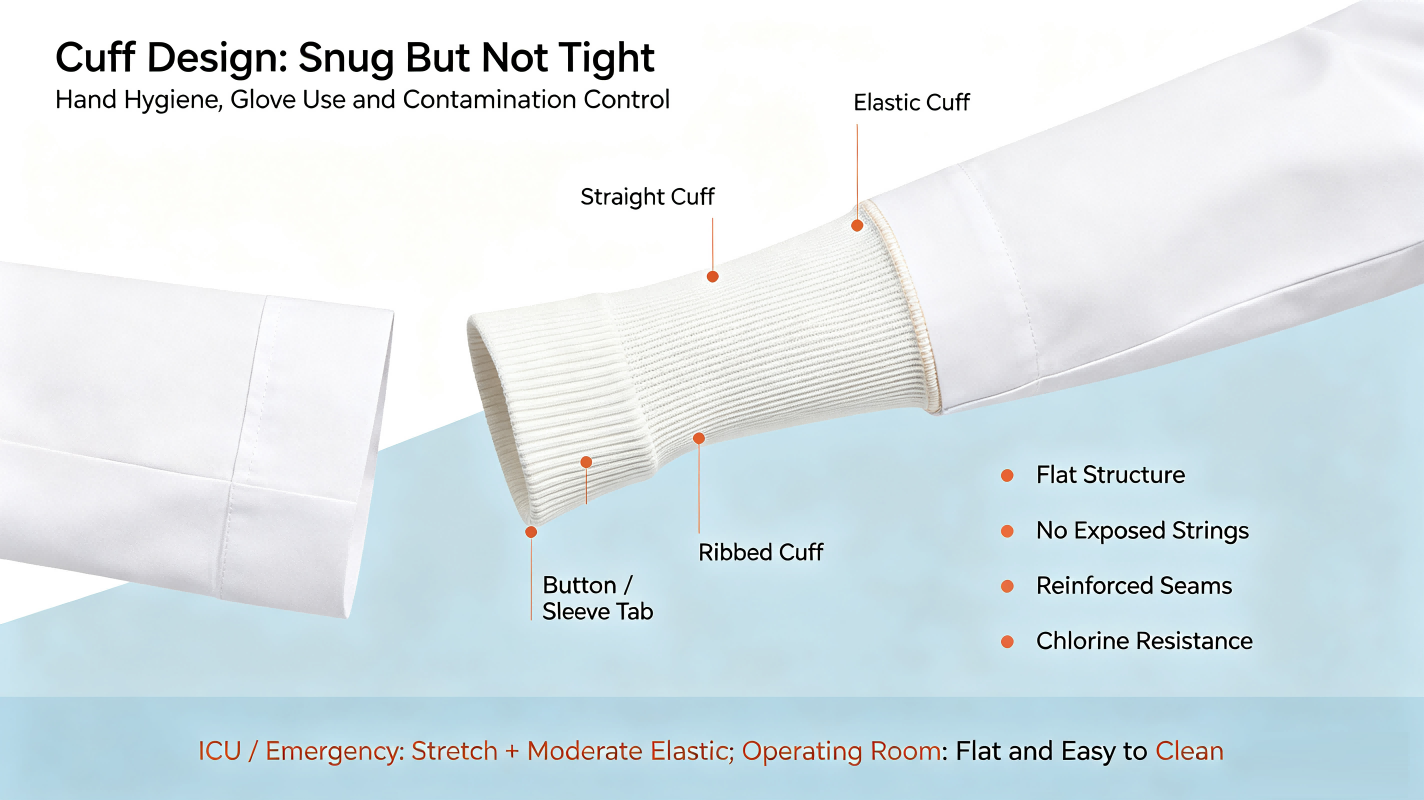
Comparison of common cuff designs
|
Cuff type |
Advantages |
Disadvantages |
Suitable scenarios |
|
Straight cuff |
Flat, easy to clean, no restriction |
Somewhat loose, may slip |
Wards, outpatient, routine nursing |
|
Elastic cuff |
Snug at wrist, prevents slipping |
Too tight can bind; elastic ages and loses stretch |
Departments with frequent movement, but elasticity must be moderate |
|
Ribbed cuff |
Elastic, snug, relatively flat |
Ribbed gaps trap dirt; chlorine resistance depends on material |
Stretch nurse uniforms, scrub suits |
|
Button/sleeve tab |
Adjustable, can be rolled up |
Buttons may fall off; tabs may catch |
Scenarios requiring rolled-up sleeves, but buttons must be reinforced |
|
Velcro cuff |
Easy to adjust |
Velcro attracts lint, ages, loses grip after washing/disinfection |
Not recommended as main cuff for nurse uniforms |
|
Bias-cut/slit cuff |
Easy to move in, doesn't bind |
Opening may turn outward, needs reinforcement |
Stretch fabric, departments requiring large movements |
Design points:
l Snug but not tight: Cuffs should fit the wrist without leaving marks; when wearing gloves, the cuff shouldn't be rolled in by the glove edge or slide out to cover it.
l Prioritise flat, low-wrinkle structures: Reduce dirt accumulation, facilitate cleaning and disinfection.
l Avoid exposed strings and overly long sleeve tabs: Necessary adjustment structures must be fixed and reinforced, with no free ends.
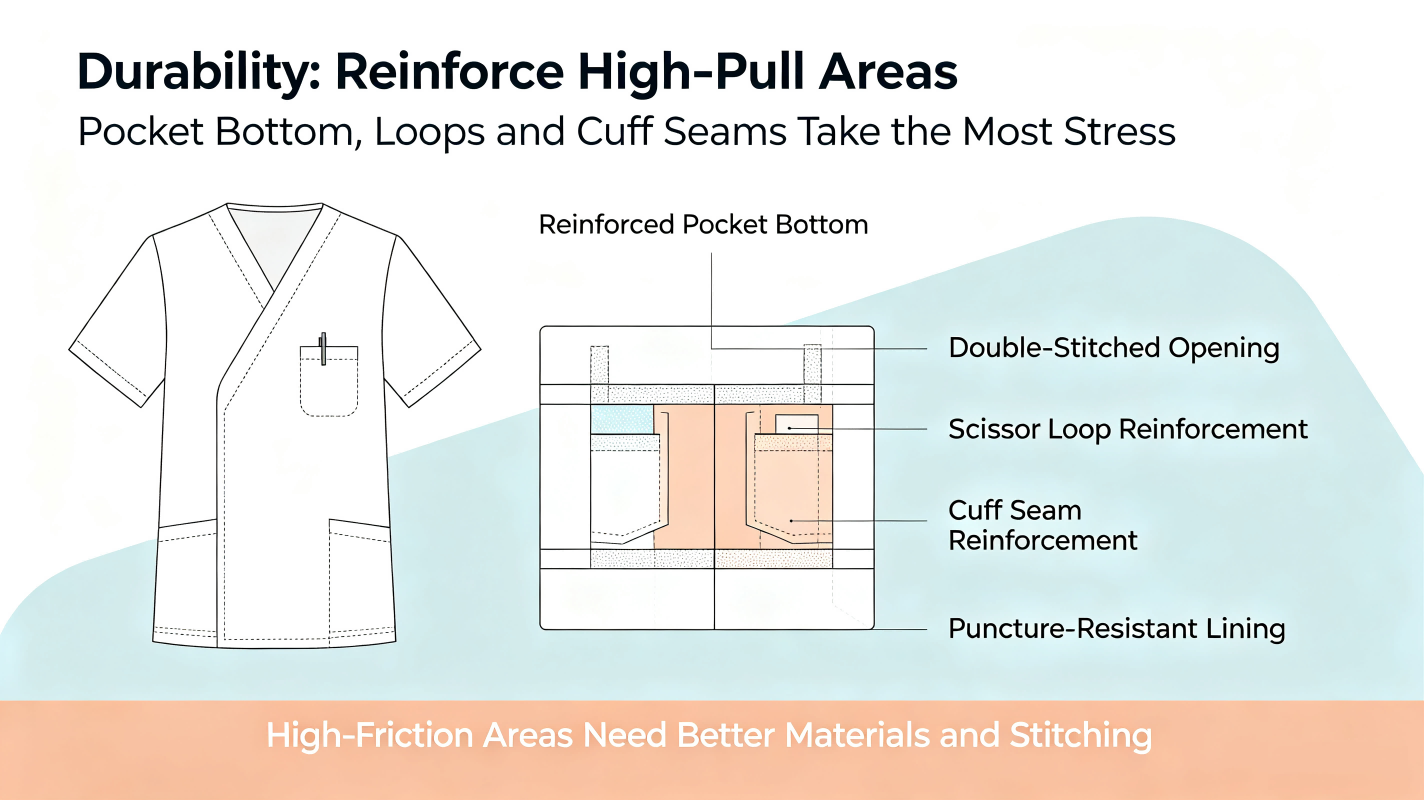
l Reinforce cuff seams: Cuffs are high-friction areas; seam splitting is a common complaint.
l Wash and chlorine resistance: Nurse uniforms are washed frequently; cuff materials must withstand repeated washing and chlorine disinfection.
Recommendations by department:
l ICU, Emergency: High activity, frequent glove use – prioritise stretch fabric + moderate elastic or ribbed cuffs, snug but not tight, easy to don and doff gloves.
l Operating room, scrub suits: Cuffs should be flat, easy to clean, easy to don/doff and withstand high-temperature washing; avoid complex decoration.
l Wards, Outpatient: Straight or slightly gathered cuffs are sufficient; focus on easy cleaning and no catching.
l Paediatrics, Psychiatry: Avoid buttons, strings, and other structures that can be grabbed; cuffs must be sturdy with no small parts.
2. Pockets: what they carry determines how they should be designed
Nurse uniform pockets aren't just "having one is enough." Nurses carry many things during a shift: pens, tape, cotton swabs, scissors, phone, keys, small notebook, stethoscope, ID badge, gloves, small bottle of hand sanitiser… Different departments carry different items. Unreasonable pocket design directly affects work efficiency.
Five core questions for pocket design
First, is the number sufficient, and are the compartments clear?
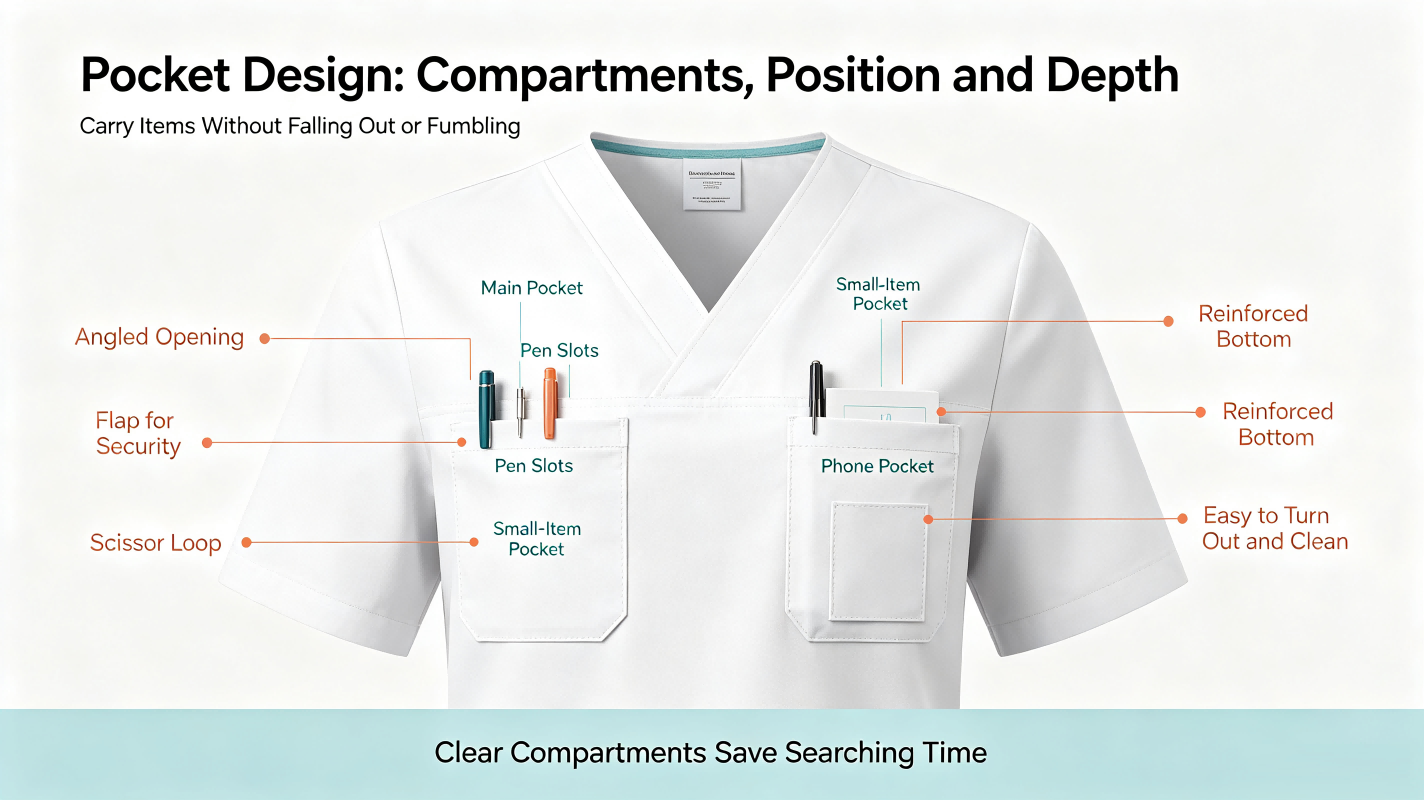
A nurse uniform with only one large pocket mixes everything together – you have to rummage for ages just to find a pen. A reasonable pocket system usually includes: main pocket (for larger items), pen slots (2–3), small-item pocket (tape, cotton swabs, keys), phone pocket (separate, non-slip), scissor pocket or loop (optional) . The clearer the compartments, the faster the retrieval.
Second, is the position right – will things fall out when bending, or dig in?
Pocket positions should avoid areas that fold or press when bending. Chest pockets too low mean items fall out when leaning over; side-seam pockets too far back dig in when sitting; hem pockets too shallow mean phones slide out as soon as you bend. Pocket opening direction matters too – angled openings are more secure than straight ones; flaps are safer than open tops, but flaps add cleaning dead corners.
Third, is the depth appropriate?
Too shallow and items fall out; too deep and you fumble around, wasting time during procedures. The main pocket depth should generally accommodate a small notebook or phone, and the pocket opening shouldn't be too far below the natural wrist position.
Fourth, are the material and structure durable?
Pockets are high-pull areas—the opening, bottom, and loops are most prone to splitting. Pocket fabric should be reinforced; the opening can have abrasion-resistant tape or double stitching. If carrying scissors, keys, or other hard objects, the pocket bottom should be puncture-resistant. The phone pocket can have a water-repellent lining, but wash resistance must be considered.
Fifth, infection control.
Pockets are where lint, pen shavings, tape residue, and cotton swab wrappers accumulate most easily. Pocket design should have few dead corners, be easy to turn out for cleaning, and have flat openings. Pockets shouldn't be too deep or narrow; otherwise, the interior is hard to clean thoroughly during washing and disinfection. Pocket fabric shouldn't be a material that easily pills or traps lint.
Pocket needs by department
|
Department/Scenario |
Key items carried |
Pocket design recommendations |
|
Wards, Outpatient |
Pens, tape, cotton swabs, small notebook, phone |
Chest main pocket + pen slots + small-item pocket, angled opening to prevent falls |
|
ICU, Emergency |
Pens, tape, scissors, phone, gloves |
Multiple compartments, scissor pocket or loop, reinforced openings |
|
Operating room/Scrub suits |
Pens, small items, ID badge |
Simple, flat, easy to clean; avoid too many outer pockets |
|
Paediatrics |
Pens, stickers, small toys, tape |
Sturdy pockets, no small parts, prevent grabbing by patients |
|
Psychiatry |
Pens, notebooks, keys |
Avoid strings and detachable small parts; pocket openings must be safe |
|
IV admixture centre/Lab |
Pens, labels, small tools |
Clear compartments, avoid cross-contamination, easy-to-clean openings |
Design points:
l Chest pocket + side pocket combination, balancing accessibility and capacity.
l Separate pen slot compartment, not mixed with the main pocket.
l Phone pocket separate, non-slip, appropriate depth, preventing the phone from slipping out.
l Angled or flapped pocket openings, secure but without excessive cleaning dead corners.
l Reinforced pocket bottom and loops, puncture-resistant where hard objects are stored.
l Pocket fabric is flat, wash-resistant, easy to clean, with no lint accumulation and no debris trapping.
3. Pen slots: small detail, big risks
Pen slots may seem like the smallest design feature on a nurse's uniform, but they involve efficiency, contamination, and occupational safety.
Why are pen slots important?
Nurses use pens extremely frequently. Recording, signing, marking, writing labels—a pen is almost always on them. Poor pen slot design leads to several problems: pens fall out easily, ink leaks stain the uniform, pen tips point the wrong way, causing puncture injuries, pens interfere with ID badges/stethoscopes, and improper slot position pokes into the chest when bending.
Five key points for pen slot design
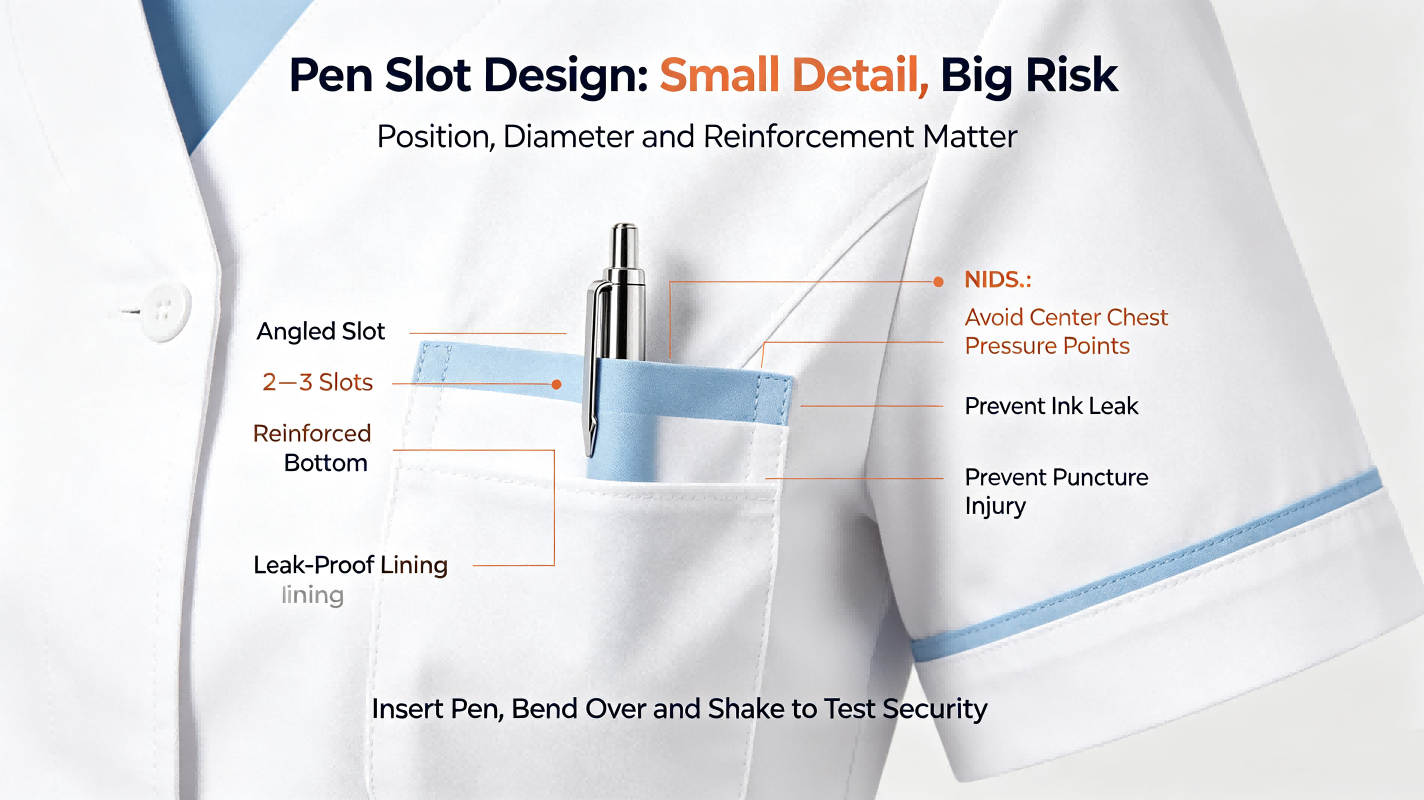
First, position: avoid the centre of the chest and bending pressure points.
Common pen slot positions are the outer chest pocket, above the pocket, or the upper arm. The centre of the chest tends to dig in when bending, and a pen tip pointing towards the body is unsafe. Angled slots are more leak-resistant and easier to access than vertical ones. The position should also avoid ID badges and stethoscope lanyards to prevent tangling.
Second, number and diameter: 2–3 is enough; diameter must match commonly used pens.
Too many slots are wasteful; too few are insufficient. 2–3 slots basically meet the need for "one recording pen, one marking pen, one spare pen." The diameter should hold the pens used securely – too loose and the pen wobbles; too tight and insertion/removal is difficult.
Third, reinforced bottom and puncture resistance.
The bottom of the pen slot is where the pen tip frequently presses, making it prone to wearing through or being pierced. The slot bottom should be thickened or double-stitched, with abrasion-resistant lining if necessary. This isn't just a durability issue – it's a safety issue to prevent the pen tip from piercing the fabric and injuring the skin.
Fourth, leak prevention and easy cleaning.
Ink leaks are a common source of staining on nurse uniforms. Pen slots can be designed as detachable pen pouches for separate cleaning or replacement, or have a leak-proof lining inside. The slot opening shouldn't be too deep, to allow easy cleaning of the interior.
Fifth, avoid small parts and free ends.
Don't add decorative small buttons, strings, or pendants to pen slots – these can be grabbed by patients in paediatrics and psychiatry, and may fall off during washing and disinfection. The pen slot itself should be flat, sturdy, and free of loose ends.
How to inspect pen slots during procurement acceptance?
l Insert commonly used pens, turn upside down, and shake gently to see if they fall out.
l Check whether the slot bottom is reinforced and whether the pen tip can reach the fabric.
l Check whether the slot position avoids ID badges and bending pressure points.
l Check whether the interior is easy to clean and free of dirt traps.
l Check whether the stitching is secure and whether there are loose threads or small parts.
4. Other details related to cuffs, pockets, and pen slots
The practicality of nurse uniforms doesn't rely solely on these three areas; several related details deserve consideration.
Buttons and zippers: Nurse uniforms should minimise decorative buttons that easily fall off. Buttons must be reinforced; zippers should run smoothly, be wash-resistant and rust-proof. Paediatrics and psychiatry should avoid small buttons that can be grabbed.
Strings and loops: Waist strings and loops must be fixed, with no long free ends. Loops can hold scissors or keys, but must withstand pulling and not catch on things.
Slits and pleats: Side slits and back pleats release movement, but the openings must be reinforced to prevent tearing.
ID badge pocket: The badge pocket should be transparent, easy to insert/remove, and flat, avoiding digging or folding when bending.
Colour and stain visibility: Light-coloured cuffs and pocket openings show dirt easily, helping timely detection of contamination; dark colours are dirt-resistant but may hide stains. Different departments need to weigh the trade-offs.
Wash durability: All details must withstand high-temperature washing and chlorine disinfection. Elastic, Velcro, decorative buttons, and coated linings are all prone to ageing; during procurement, ask clearly about wash cycles and replacement intervals.
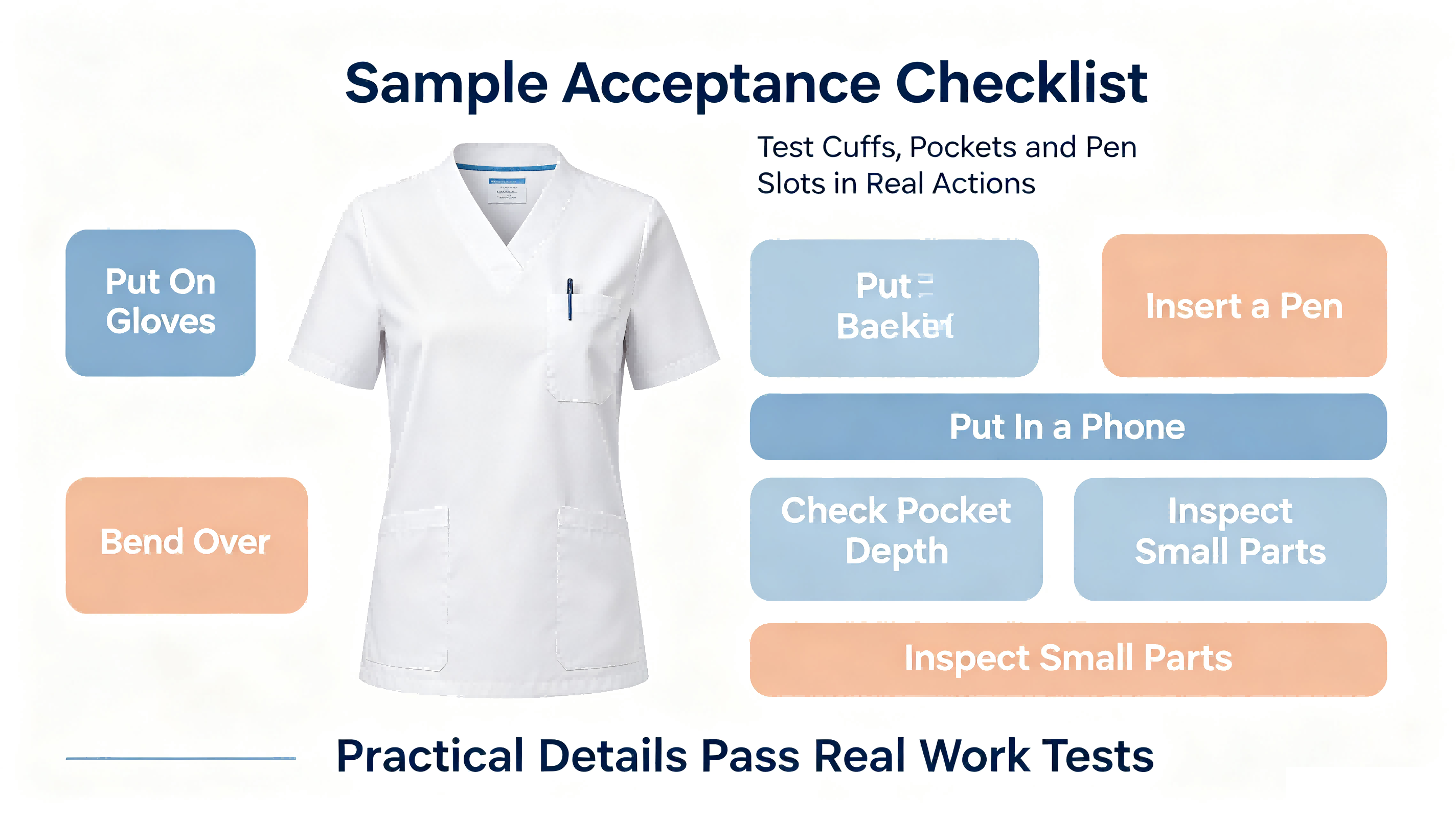
5. Procurement acceptance checklist: when you receive a sample, inspect in this order
|
Inspection area |
Inspection action |
Pass criteria |
|
Cuffs |
Don/doff gloves, roll up sleeves, raise arms |
Snug but not tight, no rolling, no slipping, no exposed strings |
|
Cuff seams |
Turn inside and out to check stitching |
Reinforced, no loose threads, withstands pulling |
|
Pocket count |
Count main pocket, pen pocket, small-item pocket, phone pocket |
Clear compartments, meets job item carrying needs |
|
Pocket position |
Bend over, sit down, turn sideways |
Doesn't dig into chest, doesn't press waist, items don't easily fall out |
|
Pocket depth |
Insert phone, small notebook, tape |
Easy to insert/remove, doesn't slip out when bending |
|
Pocket opening structure |
Check angled opening, flap, reinforcement |
Secure but easy to clean, no excessive dead corners |
|
Pocket bottom/loops |
Insert scissors, keys, pull gently |
Reinforced, puncture-resistant, no tearing |
|
Pen slot position |
Insert pen, bend over, turn |
Doesn't dig into chest, doesn't interfere with ID badge or stethoscope |
|
Pen slot security |
Insert pen, turn upside down, shake gently |
Pen doesn't fall out, smooth insertion/removal |
|
Pen slot bottom |
Feel the bottom, check stitching |
Thickened, puncture-resistant, no holes |
|
Small parts |
Check buttons, pendants, strings |
Securely fixed, no free ends, no grabbable small parts |
|
Wash care label |
Check care label and wash instructions |
Clear high-temperature and chlorine resistance requirements; detail materials wash-resistant |
6. Three common misconceptions
Misconception 1: "The more pockets, the better."
More pockets don't equal practicality. Too many pockets increase cleaning dead corners, cost, and catching risks. The key is reasonable compartments, correct position, and appropriate depth—not piling on quantity.
Misconception 2: "The tighter the cuff, the neater."
Cuffs that are too tight bind the wrist, affecting hand hygiene and glove use, and are uncomfortable over long periods. Cuffs should be "snug but not tight," compatible with gloves, and able to be rolled up for procedures.
Misconception 3: "Just sew on a pen slot anywhere."
Wrong pen slot position digs into the chest; an unreinforced bottom gets pierced by the pen tip; the wrong diameter means pens fall out. Pen slots are the smallest but most frequently used detail—they deserve serious design.
A final honest word
The cuffs, pockets, and pen slots of a nurse's uniform may look like small details, but they are actually the parts nurses use most frequently every day. Cuffs relate to hand hygiene, glove use, and contamination control; pockets relate to item carrying, retrieval efficiency, and work safety; pen slots relate to recording efficiency, ink leak contamination, and puncture risks.
There is only one standard for good detail design: it must be handy, safe, and easy to clean in real work scenarios. Cuffs snug but not tight; pockets with clear compartments, reasonable positions, and secure openings; pen slots angled, reinforced at the bottom, and not digging into the chest—these requirements aren't complex, but not many nurse uniforms truly achieve them.
During procurement, don't just look at fabric and colour. When you receive a sample, don a pair of gloves, bend over once, insert a pen, and put in a phone—many problems will be discovered on the spot. Nurse uniforms are the work equipment nurses wear every day; well-designed details mean less suffering for nurses and higher work efficiency.