Que cherchez-vous?


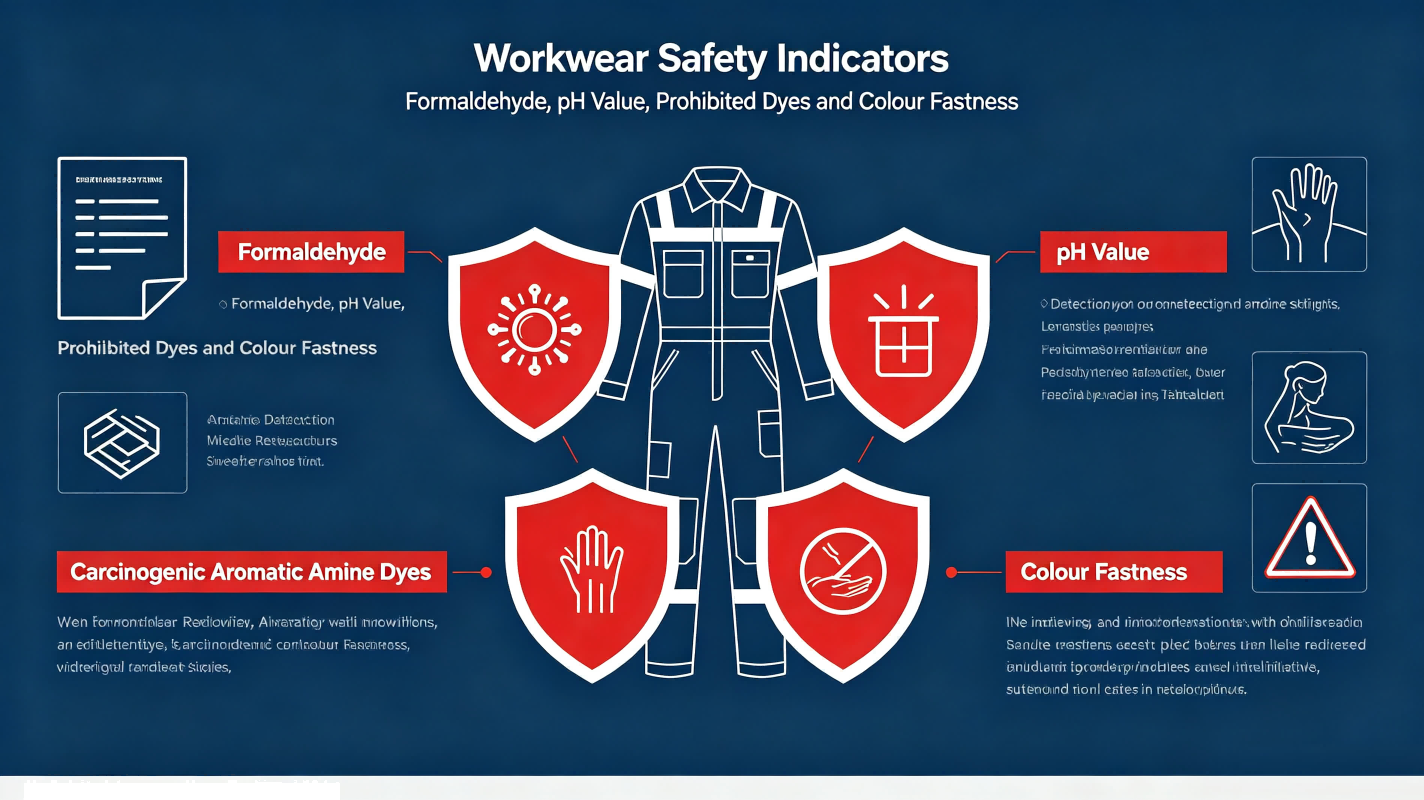
Anyone who buys workwear has probably seen this scene—a supplier holds up a garment and says, "The fabric is good quality." You flip over the tag, see "Safety category: Class B," but you're not sure what that line actually governs.
Behind that line are three key indicators: formaldehyde content, pH value, and prohibited carcinogenic aromatic amine dyes. Add one more physical indicator—colorfastness—and together they form the "four red lines" of workwear safety. Today we're going to break these down in plain language—what they are, what happens when they exceed the limits, and how to check them during procurement.
First, let's get clear: what standards govern workwear safety?
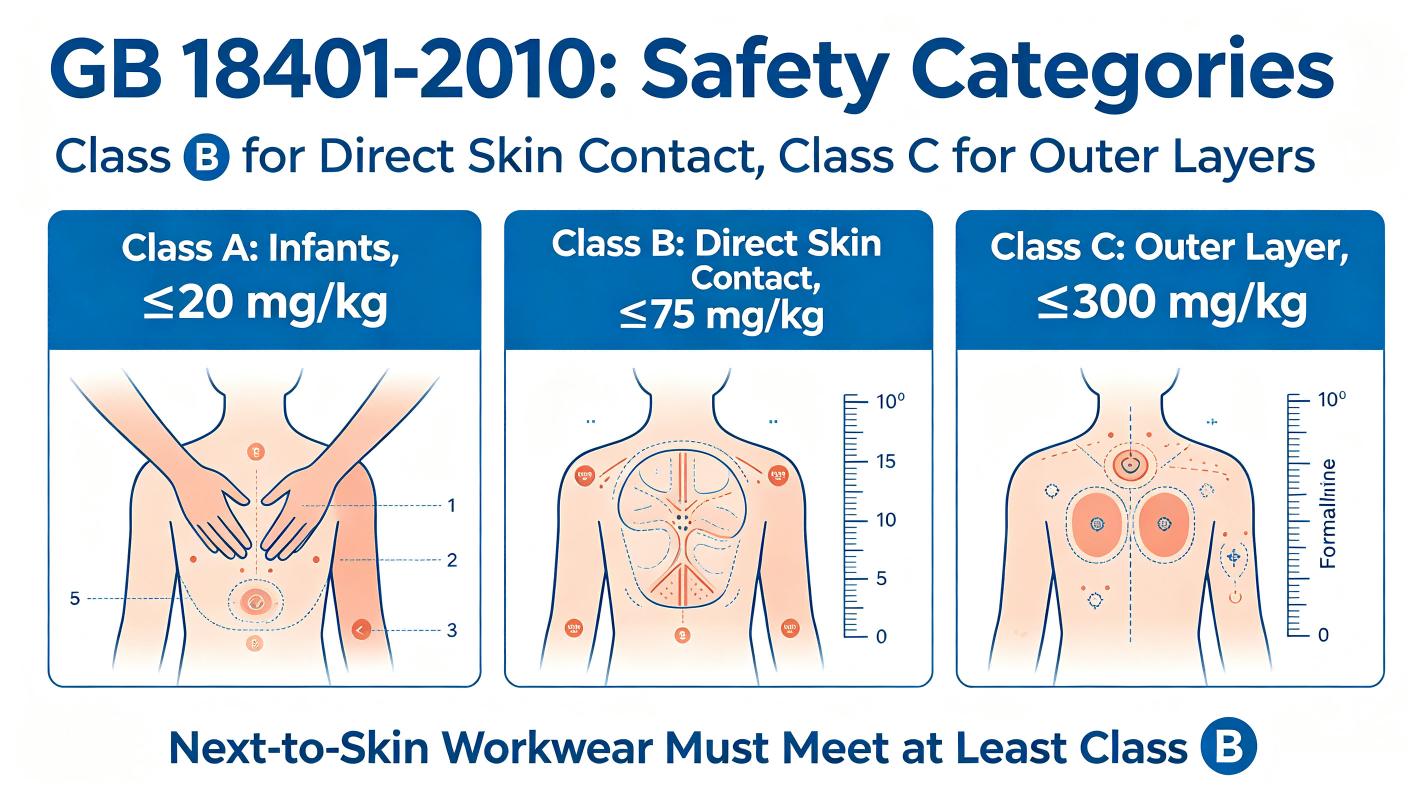
The safety indicators for workwear are mainly based on GB 18401-2010 "National General Safety Technical Code for Textile Products." This standard divides textiles into three categories:
l Class A: Products for infants and toddlers – formaldehyde ≤ 20 mg/kg
l Class B: Products that come into direct contact with skin – formaldehyde ≤ 75 mg/kg
l Class C: Products that do not come into direct contact with skin – formaldehyde ≤ 300 mg/kg
Which category workwear falls into depends on how much contact it has with the skin.
According to GB/T 41176-2021, products that come into direct contact with skin must meet at least Class B requirements, while products that do not come into direct contact with skin must meet at least Class C requirements. The applicable safety category must be marked on the instructions.
This distinction is critical. The same "workwear"—shirts, T-shirts, and underwear—must meet Class B requirements, while jackets and shell coats can meet Class C. But in reality, many buyers overlook this—they purchase for next-to-skin roles under Class C, where the formaldehyde limit is four times higher, and the safety risk is completely different.
Beyond GB 18401, some specialised workwear has its own standards. Flame-retardant clothing follows GB 8965.1-2020, anti-static clothing follows GB 12014-2019, and these standards add extra requirements on top of GB 18401. For example, flame-retardant and anti-static workwear also requires formaldehyde content ≤ 75 mg/kg.
1. Formaldehyde content: the invisible "silent killer"
Let's start with formaldehyde.
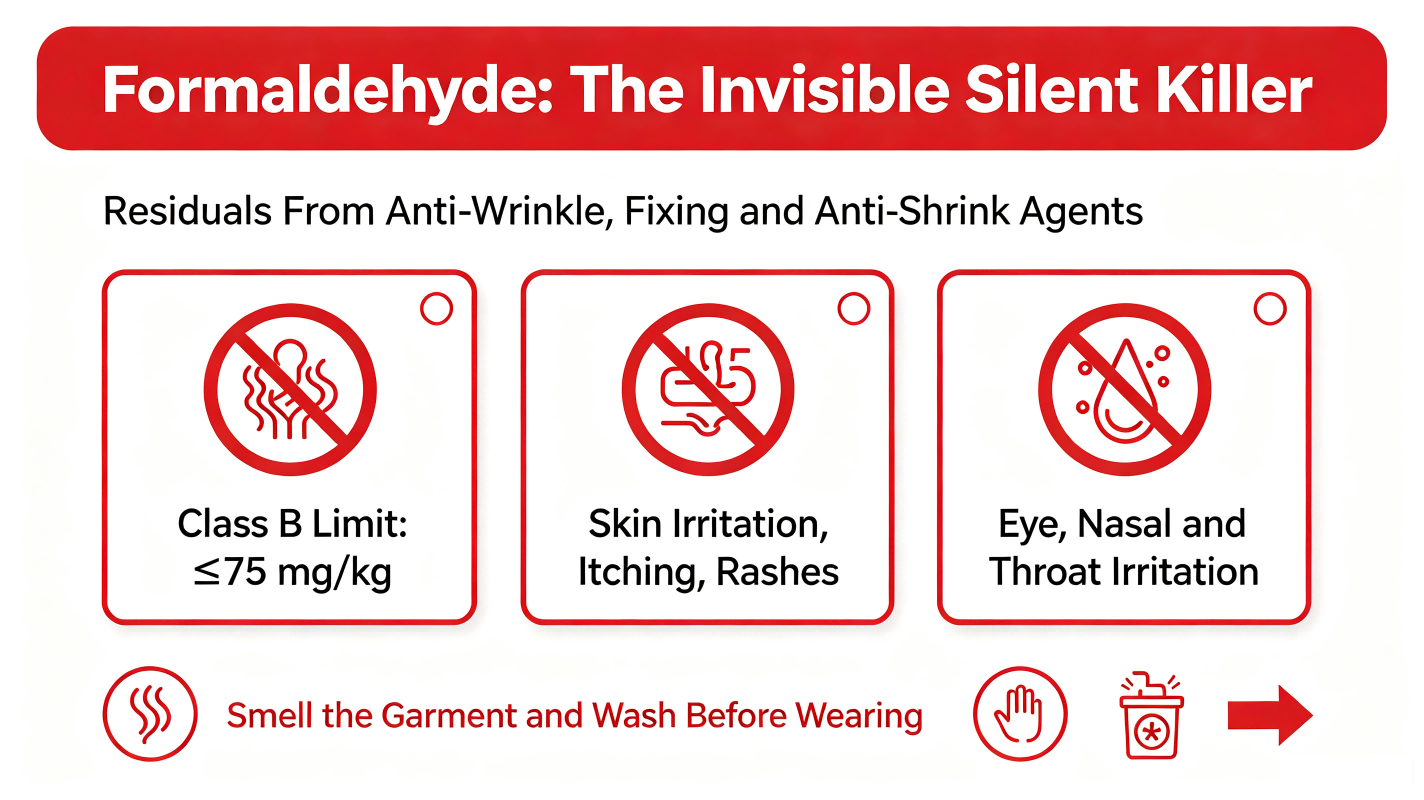
Where does formaldehyde in textiles come from? During dyeing and finishing, fabrics are treated with various auxiliaries—anti-wrinkle agents, colour fixatives, anti-shrink agents—many of which contain or produce formaldehyde. The more the manufacturer uses, and the less thoroughly they process it, the more formaldehyde remains on the garment.
The Class B standard requires formaldehyde content ≤ 75 mg/kg. Workwear that comes into direct contact with skin must meet this limit.
What are the dangers of excessive formaldehyde?
The most direct effect is skin irritation. Occupational formaldehyde exposure has been confirmed by extensive research to cause skin problems. A study on formaldehyde release from workwear showed that after patients wore new workwear, itching appeared on exposed areas of the torso, upper arms, and thighs, with symptoms highly correlated with wearing the new garments – symptoms eased on weekends and holidays. In another study, 18 out of 56 employees (32%) developed rashes, most commonly on the forearms.
Next is respiratory and eye irritation. A health hazard assessment report showed that out of 84 respondents, 95% complained of eye irritation, 72% of nasal irritation, 35% of throat irritation, and 25% of skin irritation.
How can you tell? Smell it—that's the simplest method. If new workwear has a pungent odour when you open the package—something like glue or formalin—be alert. Workwear from legitimate manufacturers is thoroughly treated before shipment to reduce free formaldehyde to safe levels. Once you receive new workwear, wash it before wearing—washing effectively reduces residual free formaldehyde on the fabric.
2. pH value: the culprit that destroys the skin's "protective film"
The pH indicator isn't familiar to many people, but it's directly related to skin health.
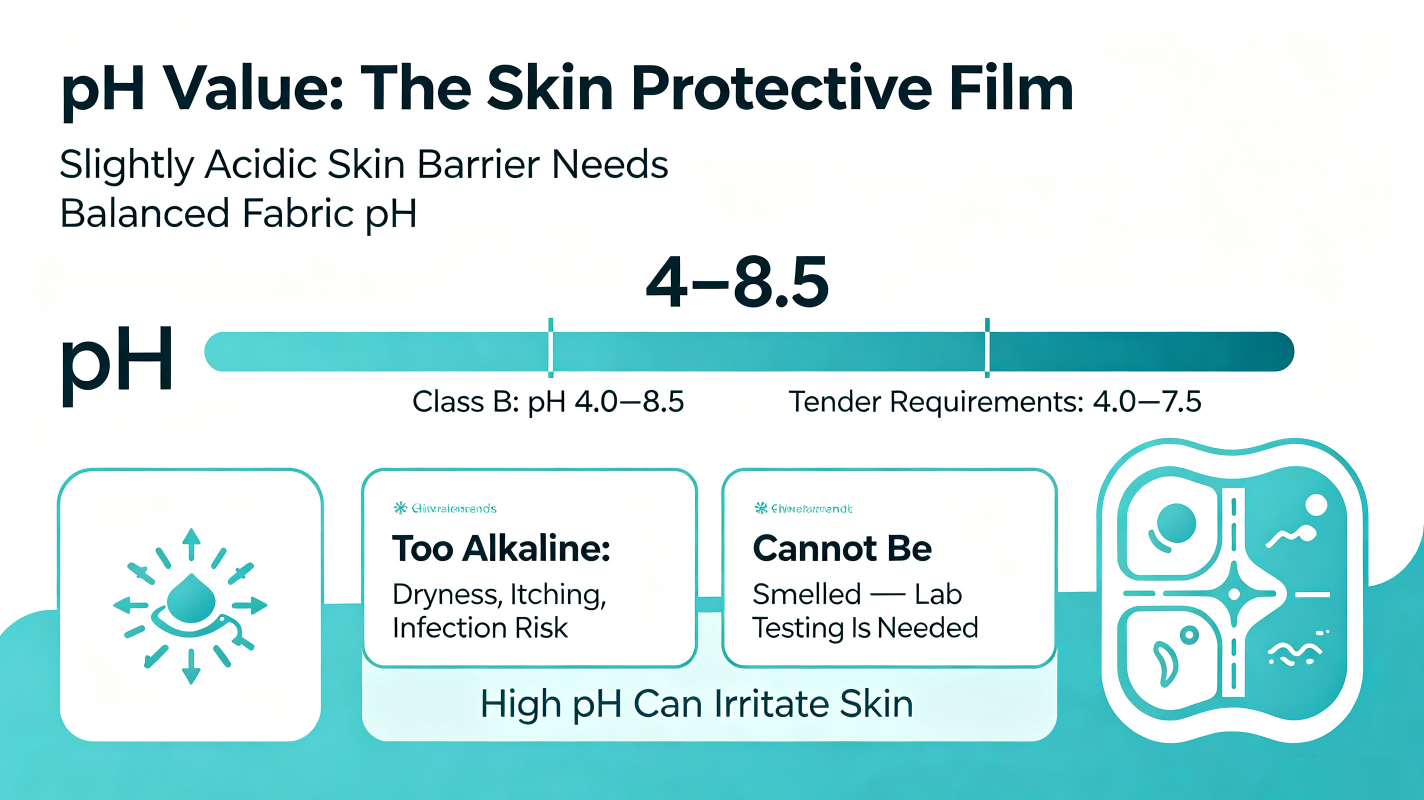
The surface of human skin is slightly acidic, with a pH of roughly 4.0 to 7.5. This mildly acidic environment is the skin's natural barrier, helping to defend against bacterial invasion. During textile production—bleaching, dyeing, finishing—acids or alkalis are used. If the fabric isn't thoroughly rinsed and neutralised afterwards, acidic or alkaline residues remain on the surface.
The Class B standard requires a pH value between 4.0 and 8.5. Many workwear procurement tenders set even stricter requirements, specifying 4.0 to 7.5.
What are the dangers of a pH value that exceeds the limit?
If the pH is too high (alkaline), it destroys the skin's slightly acidic protective film, reducing the skin's resistance—leading to dryness, itching, and even triggering allergies and infections. The National Defective Product Recall Technical Centre of the State Administration for Market Regulation explicitly states: if the pH value of clothing is too high, it can irritate the skin and even cause skin infections.
There have been many real cases. Multiple batches of workwear have been flagged in quality supervision spot checks for failing pH requirements. When such fabrics come into direct contact with skin, they can cause irritation to workers.
You can't smell a pH problem—it requires lab testing. But keep an eye out for this: if employees complain of "itching" or "prickling" after putting on new workwear, or develop unexplained rashes, consider whether the pH or formaldehyde levels might be too high.
3. Prohibited carcinogenic aromatic amine dyes: the red line you must not cross
This is the most serious of the three chemical indicators.
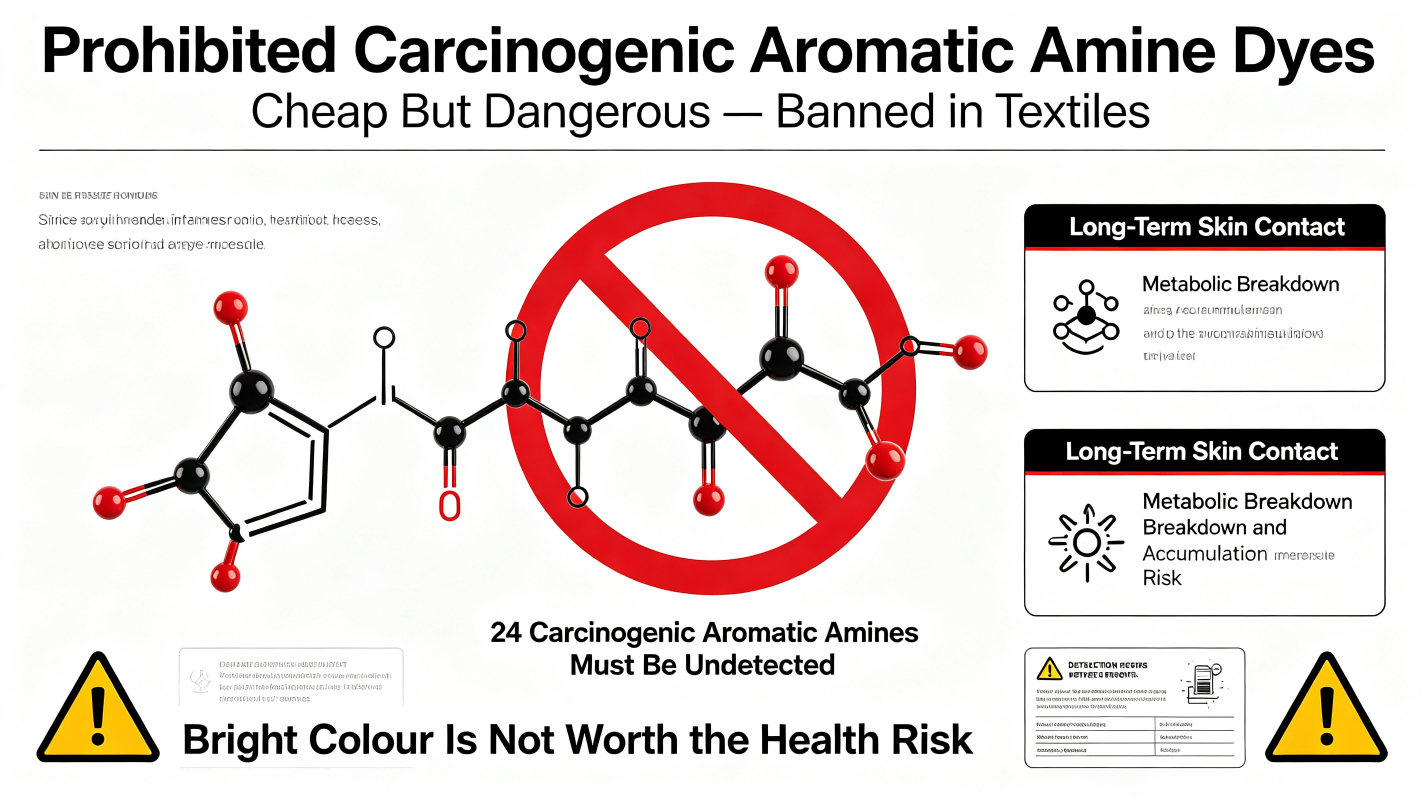
Carcinogenic aromatic amine dyes are a class of dyes that can break down under certain conditions to release carcinogenic aromatic amines. These dyes are cheap and produce bright colours, so some unscrupulous manufacturers use them to save money. The national standard is explicit: carcinogenic aromatic amine dyes are prohibited in textile products.
What are the dangers of exceeding the limit?
When carcinogenic aromatic amine dyes are absorbed through skin contact, they may break down into carcinogenic aromatic amines during metabolism. Long-term accumulation increases the risk of cancer. This isn't a "just a little itching" problem—it's a long-term health hazard.
In actual testing, products from legitimate manufacturers should show all 24 carcinogenic aromatic amines as undetected. During procurement, you can ask the supplier for the relevant test report.
4. Colorfastness: dye that doesn't "move" means skin that doesn't suffer
Besides the three "chemical indicators" above, there's another equally important physical indicator—colorfastness.
What is colorfastness? In plain terms, it's how well the colour holds up under stress. Washing, sweating, rubbing, sunlight—these everyday scenarios test how firmly the dye is bonded. Workwear with poor colorfastness fades after a few washes, and when you sweat, the dye transfers onto your skin.
The dangers of substandard colorfastness are very clear. When clothing with poor colour fastness encounters water or perspiration, the dye easily comes off and fades. Dye molecules and heavy metal ions in the dye can be absorbed through the skin, harming health. The released dye molecules can also cause irritant and contact dermatitis, and if not treated properly, may lead to bacterial infections.
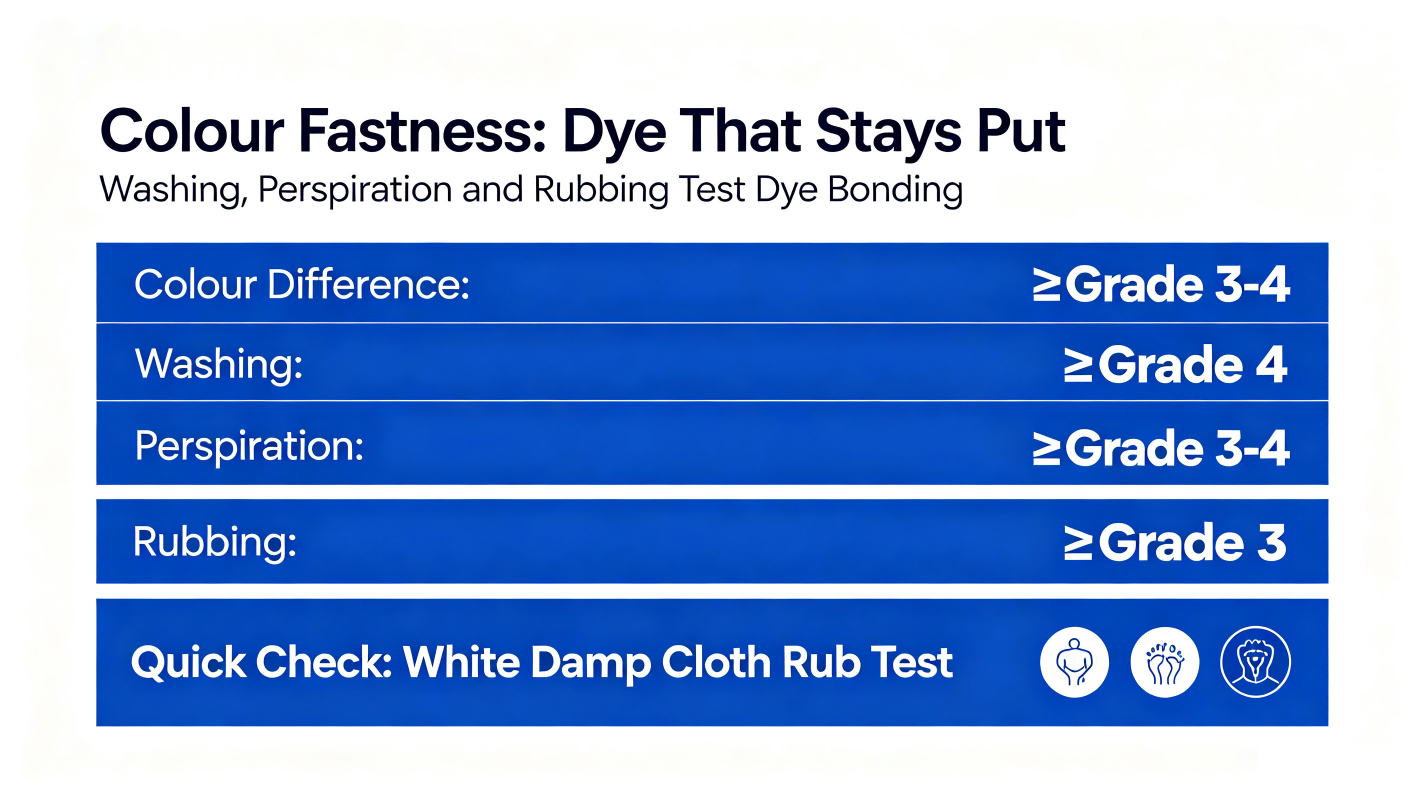
According to GB/T 41176-2021, the colour difference for workwear must be no lower than grade 3-4 on the GB/T 250 standard colour card. For specific colour fastness grade requirements, colour fastness to washing should reach ≥ grade 4, colour fastness to rubbing ≥ grade 3, and colour fastness to perspiration ≥ grade 3-4.
Rubbing the fabric with a white damp cloth provides a quick preliminary check. If it leaves obvious colour after just a few rubs, the colour fastness is likely substandard. Also, a little loose colour on the first wash of dark workwear is normal, but if it keeps bleeding colour after several washes, there's a problem.
5. Procurement in practice: four inspection actions
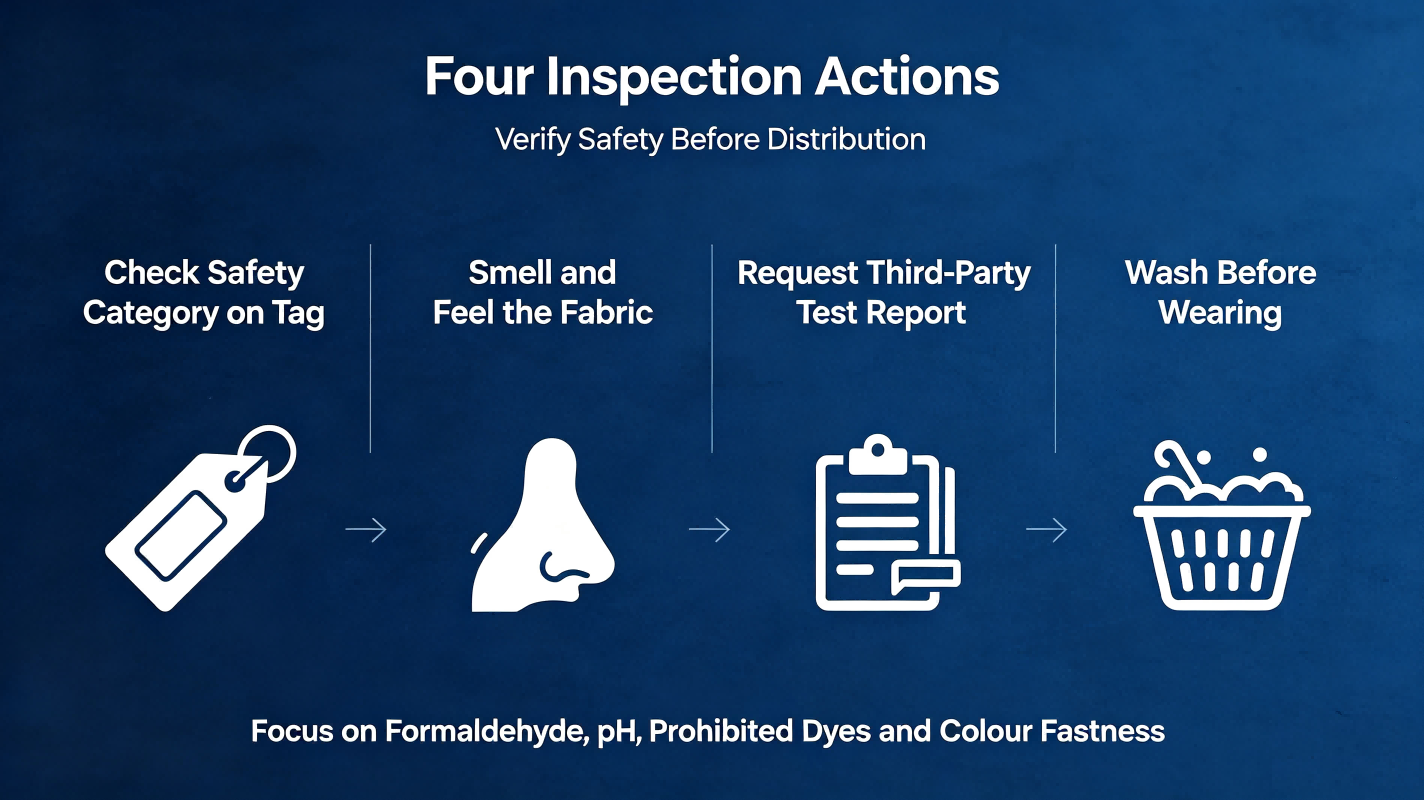
Action 1: Flip the tag and check the safety category.
Pick up the workwear and check whether the tag states "Safety category: Class B" or "Class C." Roles with next-to-skin wear must meet Class B; non-next-to-skin wear must meet at least Class C. If the tag says nothing, be suspicious.
Action 2: Smell it and feel it.
Open the package and sniff for any unusual odours—musty, petrol-like, fishy, or aromatic hydrocarbon smells are all red flags. Touch the fabric—rough or scratchy textures might indicate a problem.
Action 3: Request a third-party test report.
Ask the supplier for a test report from a nationally accredited third-party testing institution, focusing on four indicators: formaldehyde content, pH value, prohibited carcinogenic aromatic amine dyes, and colour fastness. When reviewing the report, check whether the testing standard is based on GB 18401-2010, and whether the results fall within the standard limits.
Action 4: Wash before wearing.
Once you receive new workwear, wash it once before distributing it to employees. Washing effectively reduces residual free formaldehyde and loose colour, and it helps neutralise the fabric's acidity/alkalinity. This is the simplest and most effective protective measure.
6. Common misconceptions: the pitfalls buyers fall into most easily
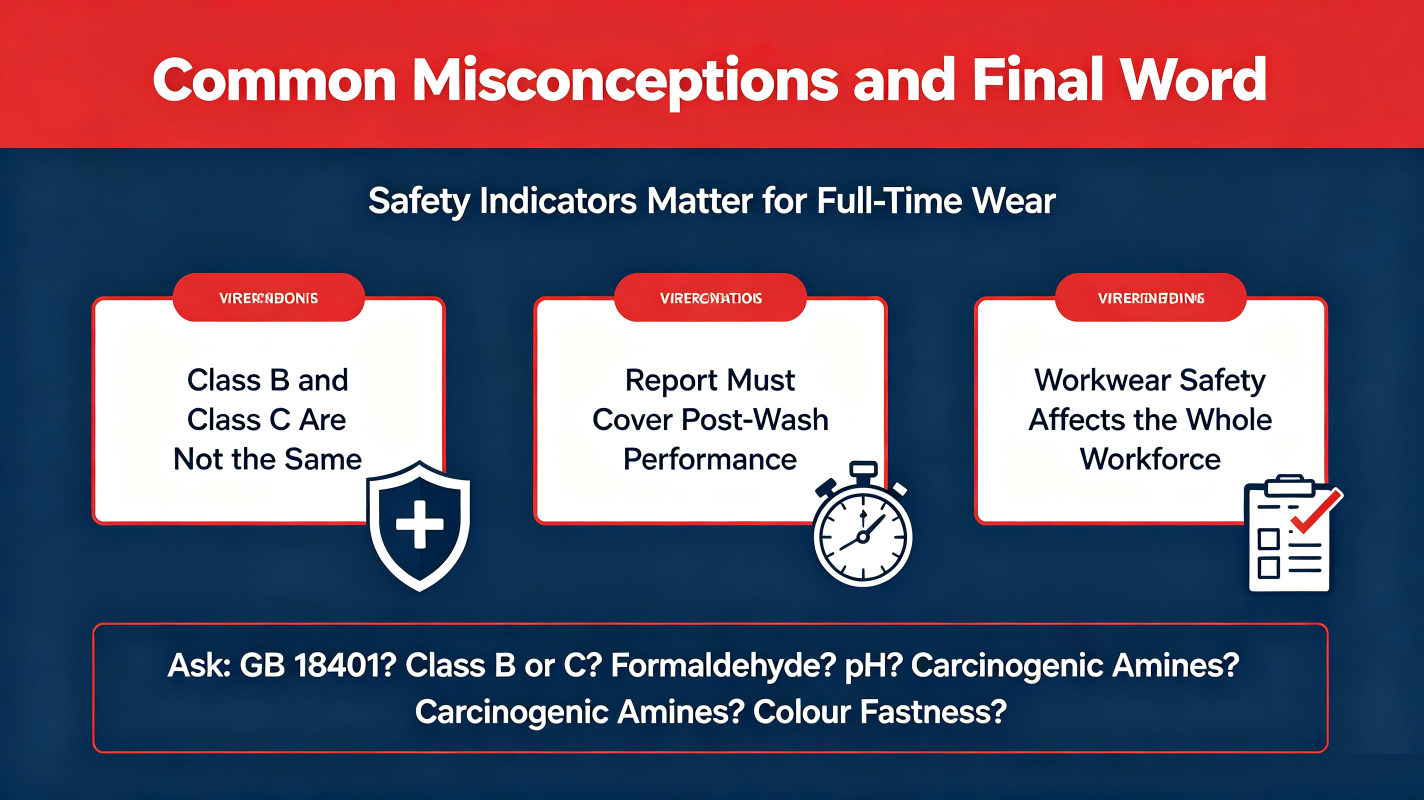
Misconception 1: "Workwear is just labour protection – safety indicators aren't that important."
Quite the opposite. Workwear is one of the garments employees wear for the longest time each day—in some roles, 8 to 12 hours. When safety indicators fail, it doesn't affect just one or two people—it affects the health of the entire workforce.
Misconception 2: "Class B and Class C are roughly the same."
They're very different. Class B formaldehyde ≤ 75 mg/kg; Class C formaldehyde ≤ 300 mg/kg—a fourfold difference. pH and colour fastness requirements also differ. Buying next-to-skin workwear under Class C is exposing employees to a much higher safety risk.
Misconception 3: "A test report means everything is fine."
Check what state the report tested—initial or after washing? Many suppliers only provide reports for initial performance, without post-wash retesting. Workwear is washed repeatedly, so the safety indicators after washing are what really matter.
A final honest word
GB 18401-2010 is the foundational standard for workwear safety indicators. For buyers, you don't need to memorise every number, but you do need to remember three things:
First, check the safety category. Next-to-skin wear must meet Class B; non-next-to-skin wear must meet at least Class C. If the tag doesn't state a category, be suspicious.
Second, check the four core indicators. Formaldehyde content (Class B ≤ 75 mg/kg), pH value (4.0–8.5), prohibited carcinogenic aromatic amine dyes (banned), and colour fastness (washing ≥ grade 4, rubbing ≥ grade 3).
Third, flip the tag, smell the garment, check the report, and wash before wearing. Do these four actions, and you'll filter out most inferior products.
Next time a supplier says, "The fabric is good quality," ask them directly: "Does it comply with GB 18401? Class B or Class C? What's the formaldehyde level? What's the pH value? Have you tested for carcinogenic aromatic amine dyes? Can I see the report?" – being able to ask those questions already makes you more professional than most buyers.